Road Roller Price Comparison: How to Normalize Quotes and Stop Hidden Costs
Two road roller quotes with the same tonnage label are rarely the same offer. Fix the spec basis, the included/excluded scope and the Incoterm first, then compare one landed-cost number — not the headline price.

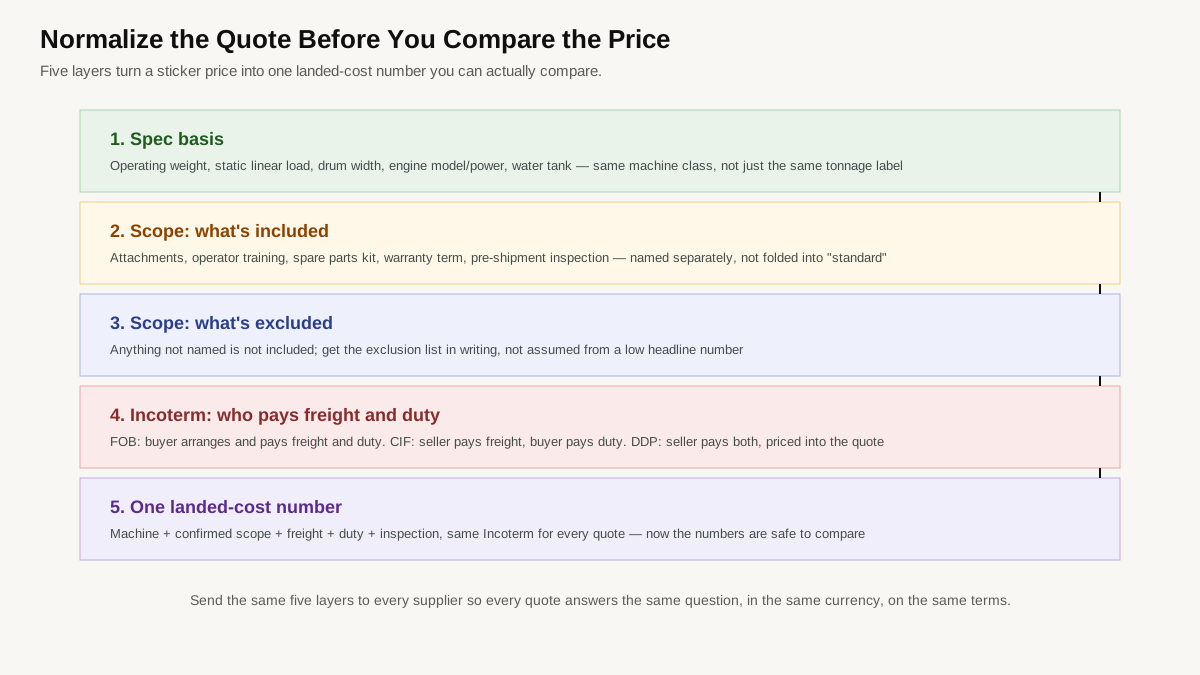
Direct answer: two road roller quotes with the same tonnage label are rarely the same offer. Before comparing any number, fix three things: the spec basis (operating weight, static linear load, drum width, engine model), the scope (what's included — attachments, training, spare parts, warranty, pre-shipment inspection — and what's explicitly excluded), and the Incoterm (who pays freight and who pays duty: FOB puts both on the buyer, CIF puts freight on the seller and duty on the buyer, DDP puts both on the seller). Once those three are locked to the same values across every quote, add them up into one landed-cost number — machine plus confirmed scope plus freight plus duty plus inspection — and compare that number, not the headline price. A quote that looks 20-30% cheaper on the surface is almost always missing one of these lines, not offering a genuinely lower cost.
Why two "same" road roller quotes aren't the same offer
A supplier quoting "a 3-ton road roller" and a supplier quoting "a 3-ton road roller" are not necessarily quoting the same machine. Operating weight, drum configuration, static linear load, vibration frequency and exciting force can all vary meaningfully within one tonnage label, and the engine model, hydraulic system and steel quality behind the number are what actually drive the price difference between two listings that look identical on a spec sheet's first line. Buyers who compare machine type, compaction task, working width and overall project size before they focus on price alone consistently make better decisions than buyers who sort a list by lowest number.
The same logic applies to the commercial terms wrapped around the machine. A request for quote that only asks "what's your price for a 3-ton roller" will get back three numbers that cannot be compared, because each supplier silently filled in their own assumptions about scope, freight responsibility and inspection. The fix is not to negotiate harder on the number you were given — it's to standardize the request so every supplier is forced to answer the same question.
This guide assumes you've already settled which type of road roller you need. If you haven't, decide that first: single drum vs double drum, walk-behind vs ride-on, pneumatic tire vs steel drum. Once the machine type is fixed, the price-normalization steps below apply the same way regardless of which one you chose.
Build the spec basis first
Before any price conversation, confirm the fields that actually define the machine class, not just the tonnage marketing label:
- Operating weight — the actual compaction mass, not a rounded marketing tonnage.
- Static linear load (front/rear) — TerraCub's own 1-ton TC-JSY700 runs 77/56 N/cm; the 3-ton TC-JS1200 runs 125/87 N/cm. Two "3-ton-class" machines from different suppliers can differ here even more than that.
- Drum width and configuration — single drum, tandem, or a combination unit changes both compaction pattern and price.
- Vibration frequency and exciting force, where vibratory compaction is required.
- Engine model, power and emissions tier — engine choice is one of the largest single line items behind a road roller's price, and China II/China IV/EPA/Euro-tier options on the same base machine are not interchangeable for every destination market.
- Water tank capacity and spray system — relevant for asphalt work; affects both price and duty-cycle.
Two quotes that agree on all of the above are quoting the same machine class. Two quotes that don't are not comparable yet, no matter how close the headline numbers look.
Scope: what's commonly included, and what to get in writing
A well-formed request for quote makes every supplier quote the same real scope: the machine fit, delivery terms, unloading and shop-power requirements, installation, startup training, warranty term and any approval or inspection requirements — not just a base machine price. In practice, the line items that most often separate a complete quote from an incomplete one are:
- Attachments and accessories actually needed for the job (spray kits, drum scrapers, transport lugs).
- Operator training — included, or a separate line item.
- Spare parts kit — and whether specific wear parts are named, or just "spares included."
- Warranty term and coverage — a stated duration and what's covered, not the word "standard."
- Pre-shipment inspection — whether an independent or factory inspection report is included before the machine ships, and what it checks.
Anything not named is not included. A lower quote very often excludes exactly these items — inspection, training, a complete spares kit — and the missing scope resurfaces later as a separate invoice once the machine is already committed to. That is not a lower cost; it's the same cost, moved to a date after the purchase decision was made and harder to negotiate away from.
Incoterms: who pays freight and who pays duty
The single biggest source of quote-to-quote price variation that has nothing to do with the machine itself is the shipping term. Three Incoterms cover most road roller export quotes:
| Incoterm | Who pays freight | Who pays import duty | What it means for your number |
|---|---|---|---|
| FOB (Free On Board) | Buyer, from the origin port onward | Buyer | Lowest quoted number; buyer arranges and pays ocean freight, insurance and destination customs clearance |
| CIF (Cost, Insurance and Freight) | Seller, to the named destination port | Buyer | Freight and insurance are priced into the quote; buyer still manages import duty and clearance |
| DDP (Delivered Duty Paid) | Seller | Seller | Highest quoted number, but every downstream cost is already inside it |
Comparing an FOB quote from one supplier against a DDP quote from another is comparing two different questions, not two prices for the same thing. Specify the same Incoterm in every request for quote so every supplier's number covers the same freight and duty scope — that is the single fastest way to stop apples-to-oranges price comparisons on road roller quotes.
Normalize to one landed-cost number
Once the spec basis and scope match and every quote uses the same Incoterm, build one landed-cost number for each supplier: machine price, plus confirmed scope items, plus freight (if not already included under the chosen Incoterm), plus duty (if not already included), plus any inspection or commissioning cost. That single number is the one that's safe to rank suppliers by — not the headline machine price alone.
For a purchase decision (rather than a rental decision), it's also worth dividing that landed-cost total by the expected annual operating hours and comparing the result to the local rental rate for a comparable machine. A higher landed-cost machine that reaches target density in fewer passes, needs less operator time, or carries a genuinely complete warranty and spares position can still be the lower true cost over the life of the machine, even when its first-column number is higher.
Red flags: why a much lower quote is usually missing something
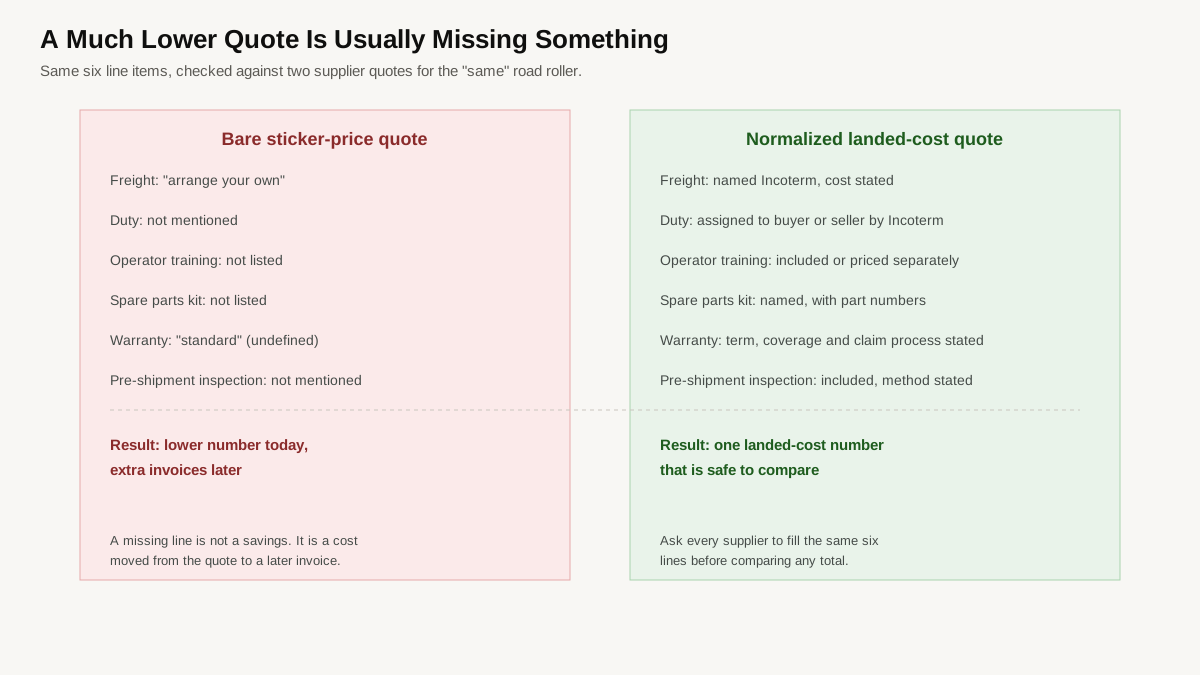
When one quote is meaningfully cheaper than the others for what appears to be the same machine, the difference is almost always one of: a lower operating-weight or specification variant sold under the same tonnage label, an exclusion the supplier didn't volunteer (freight, duty, training, a complete spares kit, inspection), or a genuinely thin-margin supplier who priced aggressively to win the order and may not be able to sustain service, spares availability or warranty support over the life of the machine. None of these are visible from the headline number alone — they only show up once every supplier has been asked to fill in the same spec basis, scope and Incoterm fields.
This doesn't mean the lowest quote is always wrong. It means the lowest quote deserves the same scrutiny as the highest one: ask what's included, ask what Incoterm the number assumes, and ask for the same inspection and warranty terms you asked every other supplier for. If a supplier can't answer those questions clearly, that's the actual red flag — not the price itself.
Get one landed-cost number, not three different questions answered three different ways
Send TerraCub your application, target spec basis, scope checklist and preferred Incoterm. We'll return a quote that answers all of it in one place, so you can compare it directly against any other supplier's normalized number.
Request a road roller quoteSend a roller quote data pack
- Application: material (soil, aggregate base, asphalt), course (base/binder vs surface), and job size.
- Spec basis: target operating weight, drum configuration (single/tandem/combination), and any vibration requirement.
- Scope checklist: attachments needed, operator training, spare parts kit, warranty term, pre-shipment inspection — ask each supplier to confirm each line, not just quote a total.
- Incoterm: specify FOB, CIF or DDP so every supplier prices the same freight/duty scope.
- Destination and logistics: port or delivery address, unloading access, and any import documentation you already hold.
- Acceptance: how the machine will be checked on arrival before final payment is released.
Send the identical data pack to every supplier under consideration. The point isn't to find the supplier who answers first — it's to make sure every answer can be placed side by side and actually compared.
FAQ
Why do road roller quotes for the "same" model vary so much in price?
Usually because the spec basis, scope or shipping terms aren't actually the same, even when the tonnage label is. Engine model, hydraulic system, steel quality and after-sales service all affect price within one weight class, and quotes commonly differ in what's included (training, spares, inspection, warranty) and which Incoterm the number assumes.
What does "landed cost" mean for a road roller quote?
Landed cost is the machine price plus every confirmed scope item, freight and import duty, added into one number under a single named Incoterm. It's the number that's safe to compare across suppliers, instead of a headline machine price that may or may not include freight and duty.
What's the difference between FOB, CIF and DDP for a road roller quote?
Under FOB the buyer arranges and pays freight and import duty from the origin port onward. Under CIF the seller pays freight and insurance to the destination port, but the buyer still pays import duty. Under DDP the seller pays both freight and duty, and the quoted number is the highest of the three but already covers everything downstream.
What should I ask every supplier to include in a road roller quote?
At minimum: operating weight and drum configuration, engine model and power, attachments needed, operator training, a named spare parts kit, warranty term and coverage, pre-shipment inspection, and the Incoterm the price assumes.
Is a much lower road roller quote a red flag?
Not automatically, but it deserves the same scrutiny as any other quote. It commonly means a lower specification variant under the same tonnage label, an unstated exclusion (freight, duty, training, spares, inspection), or a thin-margin supplier. Ask the same spec-basis, scope and Incoterm questions of the low quote that you asked everyone else.
Should I compare road roller quotes by purchase price or cost per hour?
For a purchase decision, landed cost divided by expected annual operating hours gives a more complete comparison than purchase price alone, and can be checked against the local rental rate for a comparable machine. A higher landed-cost machine can still be the lower true cost if it needs fewer passes, less operator time, or carries more complete warranty and spares support.
Sources and limitations
- ProQSmart, "10 Essential Elements Every Construction RFQ Should Include" (RFQ scope elements: delivery, insurance, maintenance terms, not just base price)
- UMPRO Tech, "Industrial Equipment RFQ Checklist" (normalize every quote to landed cost first — freight, duty, inspection inside the number, before scoring on other factors)
- International Trade Administration, "Know Your Incoterms" (FOB, CIF and DDP definitions and who pays freight/duty under each)
- ADH Machine Tool, "How to Compare Equipment Quotations Beyond Headline Price" (lower quotes commonly excluding inspection, training and support scope, resurfacing as later invoices)
- Thomcat Leasing, "The Hidden Costs of Cheap Equipment" (excluded scope resurfacing as separate invoices after purchase)
- RollerCompactor.org, Road Roller Buying Guide (comparing machine type, compaction task, working width and project size before price alone)
- TerraCub product data for the TC-JSY700 (1-ton tandem vibratory roller) and TC-JS1200 (3-ton fully hydraulic tandem roller), used to illustrate real spec-basis variation within adjoining weight classes.
This guide gives a normalization framework for comparing quotes. It does not set a universal price, freight rate, duty rate or landed-cost figure for any specific machine, route or destination market — those depend on the actual specification, Incoterm, destination country and current freight/duty rates confirmed at the time of quotation.