Interior Demolition and Soft Strip
Interior demolition and soft strip work happens inside buildings that stay standing. Crews remove partitions, ceilings, screeds, and fit-out in tight rooms, narrow corridors, and access routes where control matters more than headline machine size.
On these jobs, the right machine is the one that gets through the doorway, stays within the floor-loading limit, turns inside the room, and clears debris without creating a second damage problem on the way out.
Products
Related Products
Site Work
What interior demolition actually demands
These are the constraints that decide whether a compact machine can do the work at all, before any discussion of breakout force.
Getting the machine through the opening
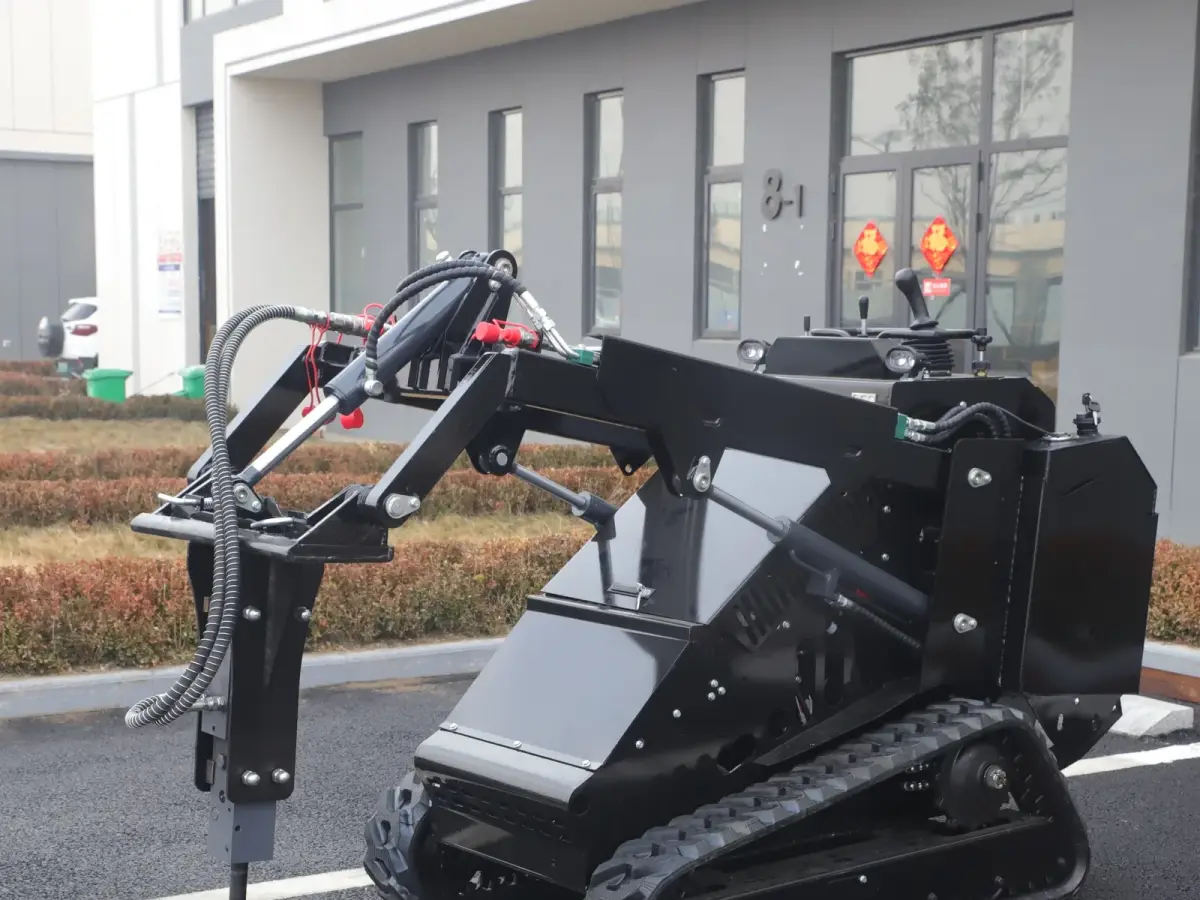
A standard internal door is around 760 mm and a fire door commonly 800 mm. The 06Q has a 700 mm transport width, so it passes without removing the frame. This single figure eliminates most machines from most interior jobs before anything else is considered.
Working on a suspended floor
A structural engineer signs off the point load, not the operator. At 660 kg operating weight, the 06Q sits in the band where a suspended slab or a timber floor with spreader mats is usually acceptable. Heavier machines require temporary propping, which costs more than the machine.
Repositioning in a room with no run-up
Interior work happens in rooms, not on sites. A 360-degree rotating body lets the machine turn and reposition against a wall instead of shunting backwards and forwards across a floor it is trying not to damage.
Breaking screed, slab, and blockwork
A hydraulic breaker matched to the carrier flow takes out floor screed, concrete slabs, and blockwork partitions. Undersized carriers stall the breaker; oversized breakers damage the boom. The pairing is the decision, not the tool.
Getting the debris back out
Breaking is the fast part. Sorting, grabbing, loading, and carrying rubble down a corridor and out through the same 760 mm door is where the day is actually spent. Plan the removal chain before choosing the breaker.
Specification
What to confirm before a machine goes indoors
The figures that matter here are not the ones on the front of a brochure. Four things decide whether the machine can legally and practically work inside a building.
Check
Transport width against the narrowest opening
Measure the tightest point on the route in, not the front door. Corridors, lift doors, and stair turns are usually tighter than the entrance. A machine that fits the building but not the corridor has not solved anything.
Check
Operating weight against the floor loading
Ask the structural engineer for the permitted point load and compare it to the machine weight plus the attachment plus the debris in the bucket. Track width spreads that load; a narrow undercarriage concentrates it.
Check
Power source and ventilation
A combustion engine indoors is an exhaust problem, and enclosed jobs increasingly specify battery-electric machines for that reason. Where a combustion machine is used, forced ventilation and gas monitoring have to be part of the method statement. Ask the supplier what power options exist before committing to a site method.
Check
Breaker matched to carrier flow
Confirm the carrier auxiliary hydraulic flow and working pressure, then match the breaker to it. This is the pairing that decides productivity, and it is the one most commonly got wrong on a first order.
FAQ
Interior Demolition FAQs
What is the difference between soft strip and interior demolition?
They describe the same work in different markets. Soft strip is the standard trade term in the United Kingdom and refers to removing non-structural elements: partitions, ceilings, fittings, and finishes. North America generally says interior or indoor demolition. A supplier selling into both markets needs both terms.
Will a mini excavator fit through a standard doorway?
The 06Q has a 700 mm transport width against a standard internal door of roughly 760 mm, so it passes without removing the frame. Always measure the tightest point on the route in, which is usually a corridor turn or a lift door rather than the entrance itself.
Can a machine this size work on a suspended floor?
At 660 kg operating weight the 06Q sits in the band where a suspended slab is often acceptable, but the decision belongs to the structural engineer, not the supplier. Give them the machine weight, the attachment weight, and the loaded bucket weight together.
Do I need an electric machine for indoor work?
Increasingly yes for fully enclosed spaces, because a combustion engine indoors is an exhaust and noise problem that ventilation may not solve economically. Battery-electric compact excavators are what the segment is moving toward. Where a combustion machine is used, forced ventilation and gas monitoring belong in the method statement. Ask about current power options before you plan the job.
How do I size a breaker to the machine?
By carrier auxiliary hydraulic flow and working pressure, not by machine tonnage. An undersized carrier stalls the breaker; an oversized breaker overloads the boom and the pins. Send the carrier model and its flow and pressure figures and the breaker can be matched to it.
What should a buyer send in the first inquiry?
The narrowest opening on the route in, the permitted floor loading, whether the space is fully enclosed or ventilated, the material being removed, the debris removal route, quantity, and timeline.
Quote
Equipment for Interior Demolition and Soft Strip
Email info@terracub.com with your site conditions, quantity, destination, and required equipment format. We will help narrow the right machine path before model selection.