Asphalt Road Roller Selection: Match Lift, Access and Output to the Job
Pick an asphalt roller class and pass pattern from four job inputs — lift thickness, mix temperature window, job width/access and production tonnage — not from a brand list or a price sheet.

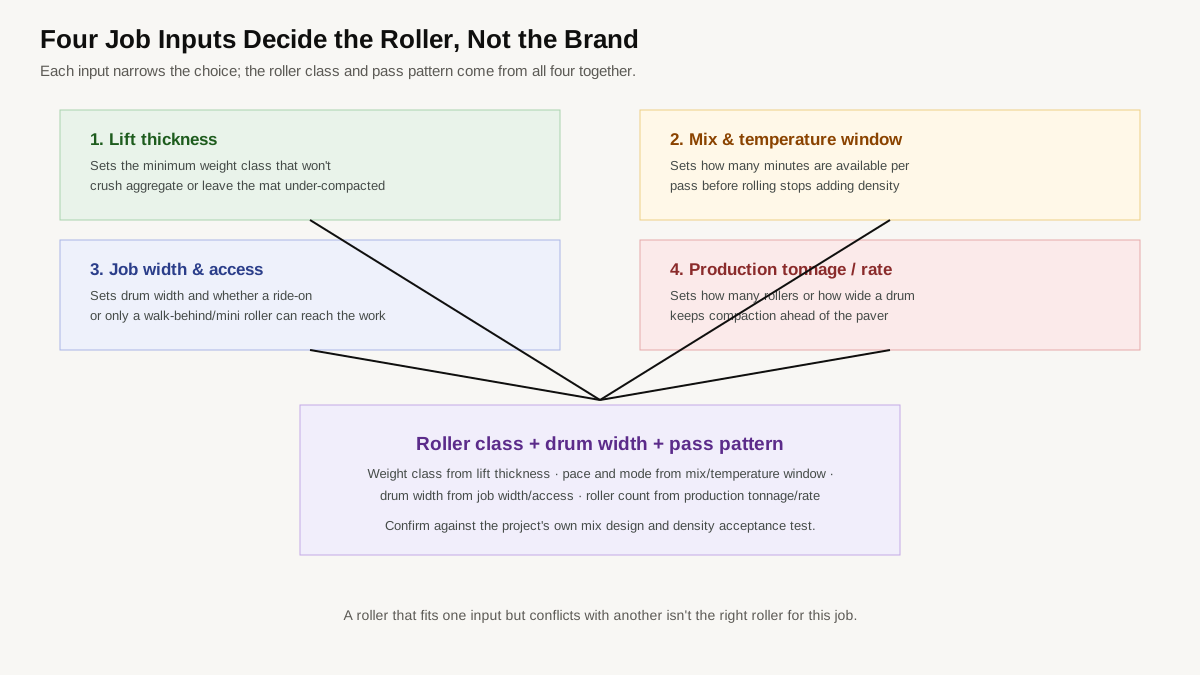
Direct answer: pick an asphalt roller class and pass pattern from four job inputs, not from a brand list or a price sheet: lift thickness (which sets the minimum roller weight class that can compact it without crushing aggregate or over-stressing a thin mat), mix type and temperature window (which sets how many minutes you actually have to complete each pass before the mat cools past the point where rolling adds density), job width and access (which sets the drum width and whether a ride-on or walk-behind/mini roller can even reach the work), and production tonnage/rate (which sets how many rollers, or how wide a drum, you need to keep up with the paver so no section goes cold before it's rolled). Once those four are fixed, the pass pattern follows a standard three-stage shape — breakdown rolling while the mat is hottest, intermediate rolling to finish density, and finish rolling for surface smoothness — timed against the mix's own compaction window, not a fixed number that applies to every job.
Why job inputs decide the roller, not the brand
This guide assumes you've already picked a machine type. If you haven't, the four other guides in this series cover those separate axes: single drum vs double drum, walk-behind vs ride-on, static vs vibratory, and pneumatic tire vs steel drum. Once the machine type is fixed, this guide answers a different question: which weight class, drum width and pass pattern actually fits this asphalt job — the one in front of you, with its own lift thickness, mix, access and tonnage — not a generic "best asphalt roller" recommendation.
The reason a generic recommendation fails is that asphalt roller capability genuinely varies with layer thickness, mix temperature, mix design (asphalt content and aggregate gradation) and ambient conditions, so the right machine for a 4-inch highway lift is very often the wrong machine for a 2-inch driveway patch, even when both are "asphalt." Reading the job's own inputs first, then matching a roller class to them, replaces a brand-vs-brand argument with a spec-vs-job argument.
Lift thickness: the minimum weight class that won't crush or under-compact
Lift thickness is the compacted layer depth the roller has to work through, and it sets a floor and a ceiling on roller class at the same time. A commonly cited rule of thumb ties acceptable lift thickness to the mix's nominal maximum aggregate size (NMAS): optimum lift thickness runs around four times NMAS, with three-to-five times NMAS as the acceptable working range. Go thinner than that and a heavy roller can crush aggregate or "check" (crack) a mat that's too thin to absorb the load; go thicker without stepping up roller weight and the mat may never reach target density before it cools out of the compaction window.
In practice, thin lifts pull toward lighter, narrower machines and thick lifts pull toward heavier ones:
- Shallow lifts (roughly 2-4 in / 50-100 mm) — patches, driveways, bike paths, thin overlays — on small, access-constrained projects commonly fit walk-behind or compact mini rollers. TerraCub's TC-YL600A (600 mm drum, 305 kg net / 320 kg operating, walk-behind) and TC-JSY700 (700 mm drum, 970 kg net) illustrate these lighter compact formats.
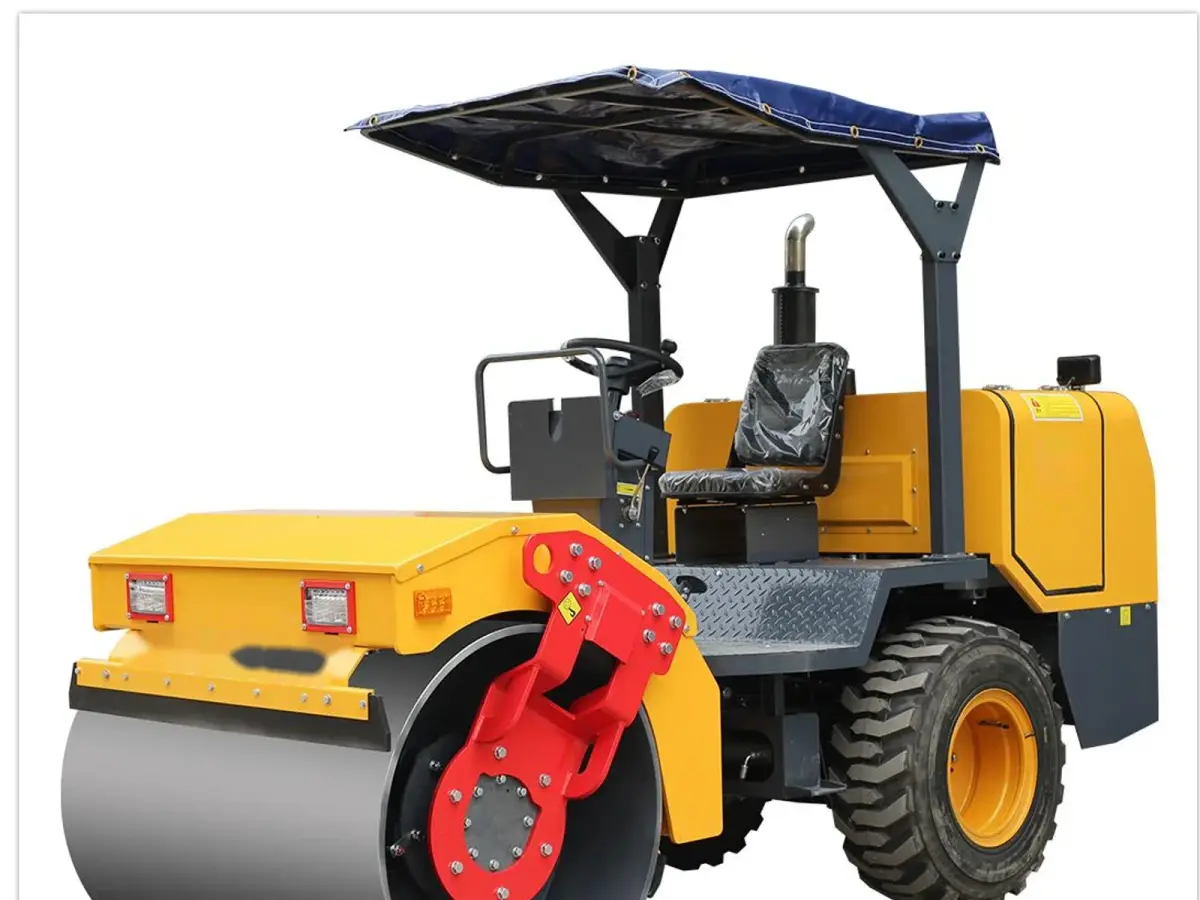
- Mid-depth lifts (roughly 2-4 in on wider lanes) — local roads, parking lots, resurfacing courses — commonly move to a 2-3 ton tandem, such as TerraCub's TC-JS1000 (1000 mm drum) or TC-JS1200 (1200 mm drum, 2900 kg net).
- Thicker structural lifts — base/binder courses on wider paving runs — move up again, toward TerraCub's TC-JS1400 (1400 mm drum, 3600 kg net, 49 hp) or larger single-drum classes for the breakdown pass.
None of these bands are universal density guarantees; always confirm actual (not nominal) lift thickness against the project's own mix design and acceptance test before locking in a roller class.
Mix type and temperature window: how much time you actually have
Weight class only matters if the roller can finish its passes before the mat cools past the point where rolling stops adding density. Industry references describe hot-mix asphalt (HMA) timing with generalized planning ranges rather than one hard universal window. One commonly cited effective band runs roughly from 275°F down to 175°F mat temperature, while stage guidance also places some breakdown work above 290°F and some finish work as low as 160°F. Treat these as overlapping, mix-specific ranges from different operating contexts, not as three stages that must all fit inside 275-175°F. Confirm actual start and stop temperatures against the mix design and project specification. Commonly cited stage ranges are:
- Breakdown rolling — the highest-density pass, most efficient starting above roughly 290°F (145°C) and generally completed before the mat falls below roughly 240°F.
- Intermediate rolling — the workhorse pass for reaching target density, typically carried out in roughly the 200-250°F range.
- Finish rolling — for surface smoothness only, typically carried out in roughly the 160-200°F range, and not expected to add meaningful density.
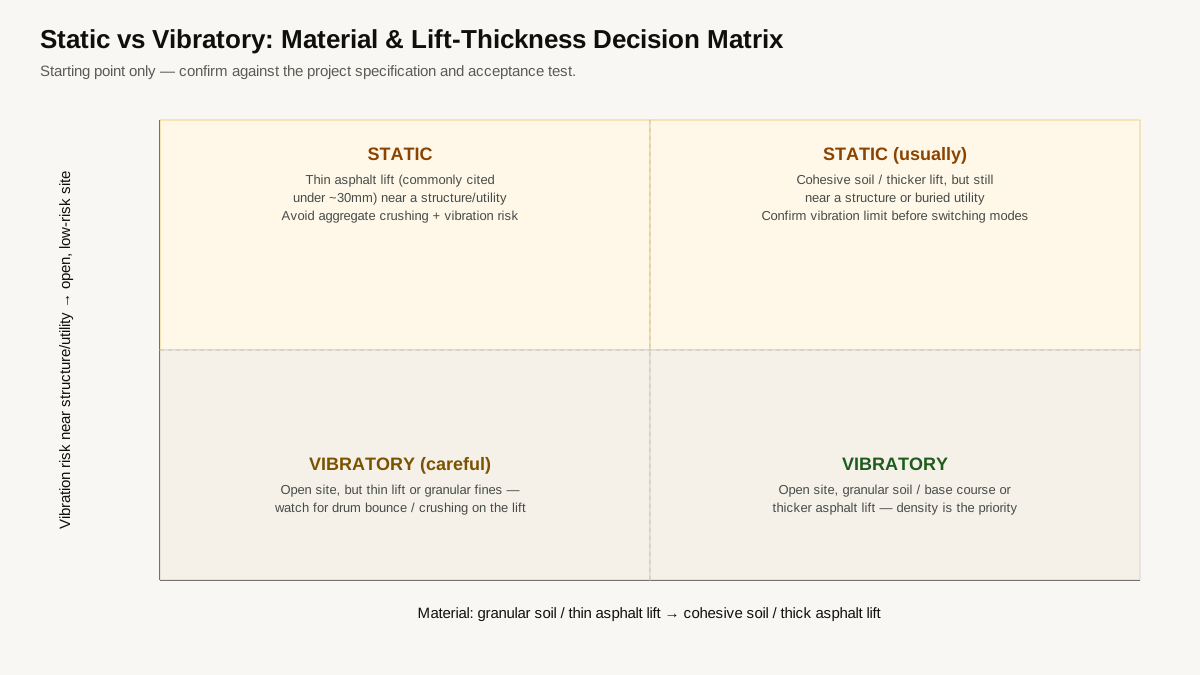
Ambient conditions compress or extend that window sharply: a standard 2-inch lift at 70°F with no wind can offer 15-20 minutes of compaction time, while dropping ambient to 50°F with a light breeze can shrink that to 8-12 minutes on the same lift. There is also a "tender zone" — often cited around 180-220°F depending on mix design — where the mat can shove or tear under rolling if the wrong roller type or too much vibratory energy is applied at the wrong moment; this is one reason mix type and mechanism choice (see the static-vs-vibratory guide above) interact with temperature, not just with weight.
Job-input takeaway: a colder job site, a thinner lift, or a mix with a narrower working range all shrink the available time per roller pass, which argues for either a faster/wider roller, an added roller in the train, or fewer total passes planned per stage — not for compacting harder once the window has already started closing.
Job width and access: matching drum width to the work
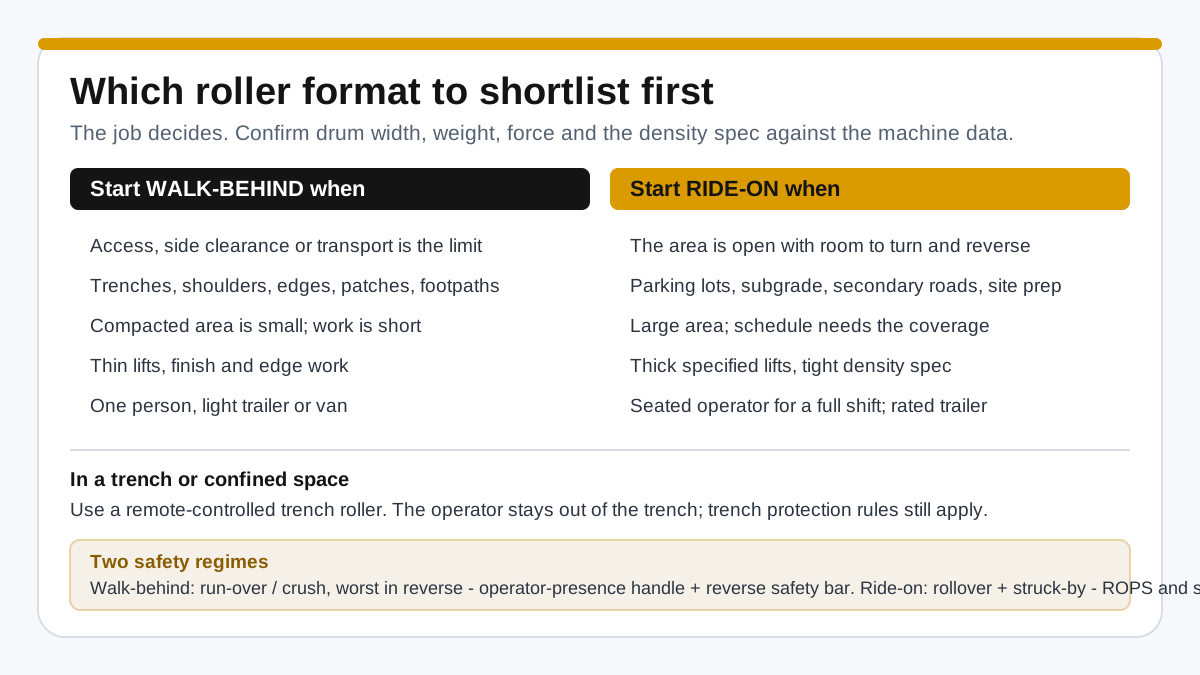
Job width and site access decide which machines can physically do the work, independent of weight class. Ride-on asphalt rollers commonly cover the 32-84 in drum-width range, while smaller pull-along and walk-behind units cover roughly 14-32 in, letting them work in trenches, tight urban patches and other confined footprints a ride-on machine can't enter. TerraCub's own range spans this: TC-YL600A and TC-YL450 (walk-behind, 450-600 mm drums) for confined patch work; TC-JSY700 through TC-JS1000 (700-1000 mm drums) for single-lane and driveway-scale jobs; TC-JS1200 through TC-JS1400 (1200-1400 mm drums) for wider lanes and parking-lot-scale runs.
Access constraints that should be checked before drum width, not after: overhead clearance, gate or trench width, turning radius at the job's tightest point, and whether any part of the work is below grade or otherwise unreachable by a ride-on unit. A wider drum reduces the number of passes needed to cover a given width, but only if the machine can physically get into position — a wide, heavy roller that can't enter the site is not a viable option regardless of how well its weight class matches the lift thickness.
Production tonnage and rate: keeping the roller ahead of the paver
The paver's own output — how many tons per hour it's laying — sets how much compaction capacity has to be standing by, because the roller team has to complete initial compaction on each section before the next section of hot mix arrives, or that first section cools out of its window while still uncompacted. Plant/paving output can be estimated as paving width × paving speed × layer thickness × mix density × a time-unit conversion factor; when that output rises faster than the compaction train can cover, hot mix piles up, cools and becomes difficult or impossible to compact properly, and cold spots appear in the finished mat.
The practical fix is on the compaction side, not the paving side: add roller capacity (a wider drum, or an additional roller in the train) rather than continuing to pave faster than the rollers can follow. The breakdown roller is normally the most heavily loaded machine in the train — commonly a double-drum vibratory unit in the 10-12 ton range on larger paving jobs — because it does 60-70% of the total compaction work on the hottest mat; on a smaller job with a correspondingly smaller paver output, a single mid-weight tandem roller cycling continuously between breakdown and intermediate passes can keep pace instead. Ambient temperature affects this balance too: temperatures below roughly 50°F can cut paving/rolling output by around 30% because the mix cools faster, which argues for slowing the paver, shortening the lift, or adding a roller — whichever keeps compaction inside the mix's own temperature window.
Build the pass pattern: breakdown, intermediate, finish
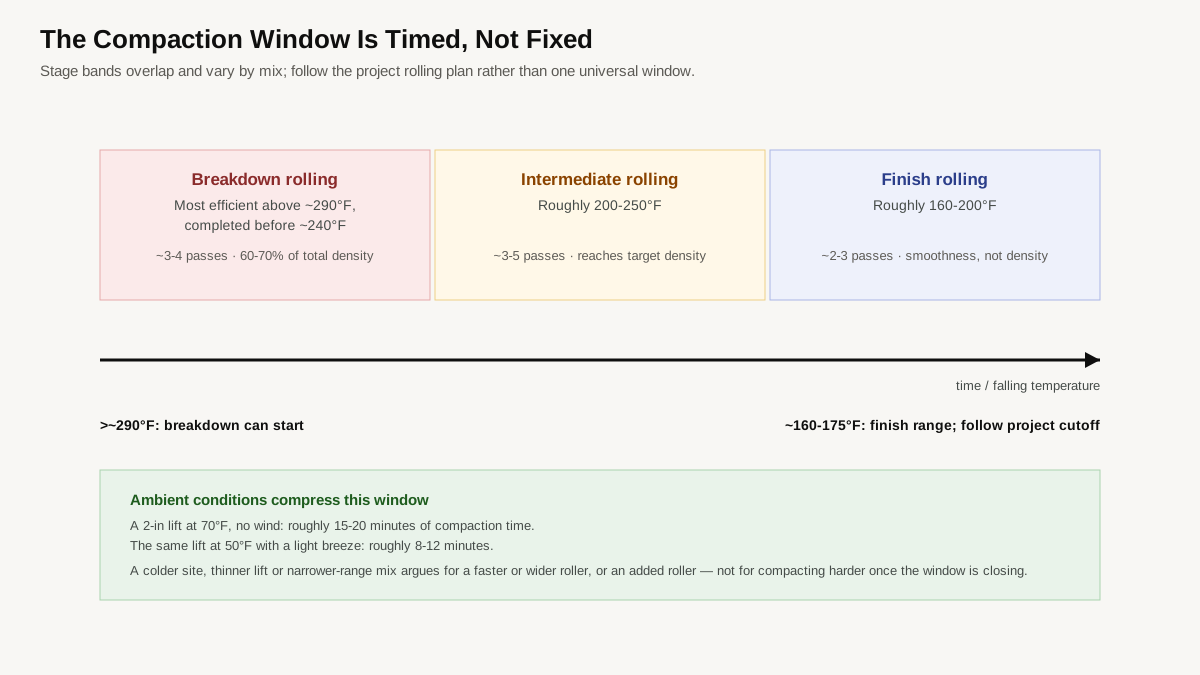
With weight class, drum width and available time all set by the three job inputs above, the pass pattern itself follows a repeatable three-stage shape:
- Breakdown — the heaviest available roller in the train, working as close behind the paver as safely possible while the mat is hottest; commonly 3-4 passes.
- Intermediate — reaches most of the remaining target density; commonly 3-5 passes, and where vibratory-vs-static mode choice (see the static-vs-vibratory guide) matters most.
- Finish — smooths roller marks and joints without adding meaningful density; commonly 2-3 passes, usually with the roller in static mode.
The correct pass count for any given job is the lowest repeatable number of passes that reaches the project's specified density while the mat is still workable — not a fixed number carried over from a different lift thickness, mix or temperature window. Always confirm final pass count and density acceptance against the project specification or a proof-rolling/density test, not against a number from this guide or any other general reference.
Two worked examples
| Job input | Small patch / driveway job | Wider single-lane resurfacing job |
|---|---|---|
| Lift thickness | ~2 in patch | ~2-3 in overlay |
| Job width / access | Narrow, gated driveway; below-grade trench section | One full traffic lane, open access |
| Production rate | Small batch, delivered by truck, no continuous paver | Continuous paver train, higher tons/hour |
| Indicated roller class | Walk-behind or mini ride-on, 450-700 mm drum (e.g. TC-YL600A, TC-JSY700) | 2-3 ton tandem, 1000-1200 mm drum (e.g. TC-JS1000, TC-JS1200), cycling breakdown/intermediate |
| Pass pattern | Combined breakdown+intermediate in static or low-amplitude vibratory mode, 1 roller | Separate breakdown and intermediate passes; add a second roller if paver output outruns single-roller coverage |
These two examples illustrate the framework; they are not a universal spec for every patch job or every lane job. Confirm actual lift thickness, mix design, access dimensions and paver output for the specific job before finalizing a roller class or pass count.
Match a roller class to your actual job inputs
Send TerraCub your lift thickness, mix type and paving-season temperature range, job width and access constraints, and expected tonnage or paver output. We'll point you to the TerraCub roller class and drum width that fits, not a generic recommendation.
Get a job-input roller matchSend a job-input data pack
- Lift thickness: target compacted depth and mix NMAS, if known.
- Mix type and season: hot-mix, warm-mix, or cold-mix; typical ambient temperature range during paving.
- Job width and access: lane/patch width, overhead clearance, gate or trench width, turning radius.
- Production rate: paver output (tons/hour) if continuous paving, or batch size if not.
- Density/acceptance method: proof-rolling, nuclear gauge, or another project-specified test.
- Machine-type decision already made: drum count, operator format, compaction mode and contact-surface preference, if already chosen.
FAQ
What's the single most important input for choosing an asphalt roller?
There isn't one — lift thickness, mix temperature window, job width/access and production tonnage all interact. A roller that's the right weight for the lift thickness but too wide for the site access isn't usable, and a roller that fits the access but can't keep pace with paver output will let sections go cold before they're compacted.
How thick can a lift be before I need a heavier roller?
A commonly cited rule of thumb sets optimum lift thickness at about four times the mix's nominal maximum aggregate size, with three-to-five times NMAS as the acceptable range. Thinner lifts risk aggregate crushing or mat cracking under too heavy a roller; thicker lifts risk under-compaction under too light one. Always confirm against the project's own mix design and acceptance test.
How long do I actually have to compact before the mat cools too much?
There is no single hard temperature window for every HMA mix. One commonly cited effective band runs roughly from 275°F down to 175°F, while stage guidance may start breakdown above 290°F and continue finish rolling as low as 160°F. Treat these as overlapping, mix-specific planning ranges and follow the mix design and project specification for actual limits. Ambient conditions also change the available time sharply: a 70°F day with no wind can offer 15–20 minutes on a standard 2-inch lift, while a 50°F day with light wind can shrink that to 8–12 minutes on the same lift.
How do I know if I need more than one roller?
Compare paver output (tons/hour) against how much width and time your compaction train can cover before the mat cools. If the roller team can't complete initial compaction on a section before the next section of hot mix arrives, add roller capacity — a wider drum or an additional roller — rather than paving faster than the rollers can follow.
Does drum width matter more than roller weight?
Neither dominates on its own. Drum width has to fit the job's physical access and reduces passes needed to cover a given width; weight class has to fit the lift thickness and mix. A wide, heavy roller that can't physically reach the work is not viable regardless of how well its weight matches the lift.
Is the breakdown/intermediate/finish pass pattern the same for every job?
The three-stage shape is standard, but pass counts within each stage (commonly 3-4 breakdown, 3-5 intermediate, 2-3 finish) and the total time available are set by this job's own lift thickness, mix and temperature window — not a fixed number that applies to every job. Confirm final density against the project specification or a proof-rolling/density test.
Sources and limitations
- Asphalt Institute, Engineering FAQs — Pavement Thickness and Mix Design (lift thickness relative to nominal maximum aggregate size)
- Roads & Bridges, "Compacting Hot-Mix Asphalt Pavements: Part II" (breakdown/intermediate/finish temperature bands and roller roles)
- Sakai America, "Basics of Asphalt Compaction: Mix, Density, Benefits, Temps" (compaction temperature window and tender-zone behavior)
- MMS Industrial, "Asphalt Roller Pass Count for Density and Smoothness" (typical breakdown/intermediate/finish pass counts)
- Aimix Construction, "How to Match Asphalt Plant Production Speed with Paving and Rolling Capacity" (production-rate formula and roller-capacity coordination)
- AsphaltPro Magazine, "How to Roll for Bonus, Part 2" (breakdown roller weight class and share of total density achieved)
- DOZR, "The Ultimate Road Roller Size Chart and Spec Guide" (ride-on vs pull-along/walk-behind drum-width ranges)
- Blades Direct, "How to Choose a Roller Compactor Size" (shallow-lift, small-project roller-size guidance)
- TerraCub product data (
data/road-roller-products.json) for TC-YL600A, TC-YL450, TC-JSY700, TC-JS1000, TC-JS1200 and TC-JS1400 drum widths and weight classes, used to illustrate real job-input-to-class mapping across TerraCub's own range.
This guide gives a job-input decision framework for matching an asphalt roller class, drum width and pass pattern to a specific job. It does not set a universal lift thickness, temperature window, pass count or density figure for any specific mix, project specification or destination market — those depend on the actual mix design, project specification and an on-site density/acceptance test confirmed at the time of paving.
Recommended Products
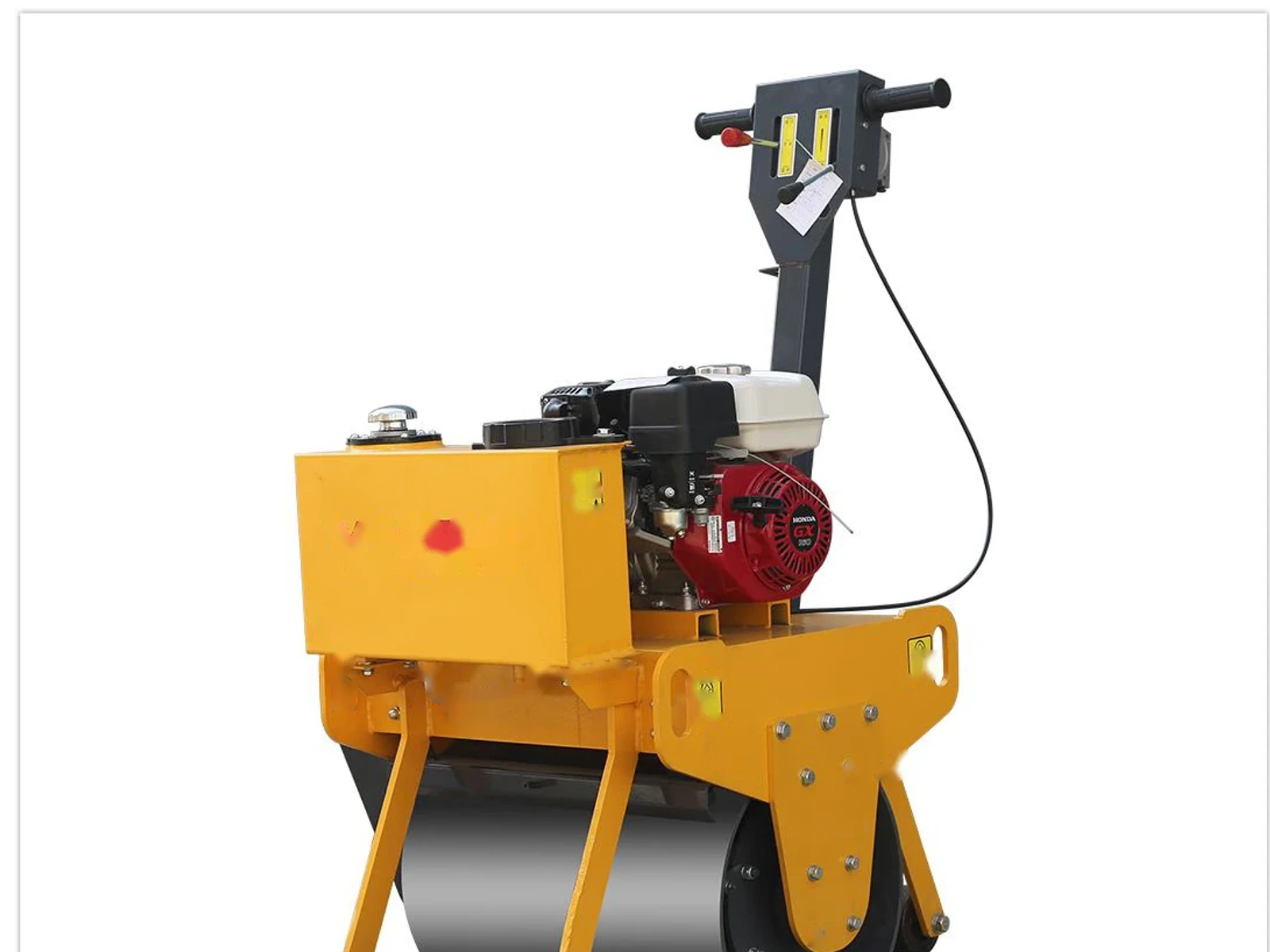 Walk-Behind Single-Drum Road Roller TC-YL600A
Walk-behind single-drum roller widely used to compact asphalt surfaces, gravel and sandy engineering foundations; high performance, easy operation, long service life.
View Product →
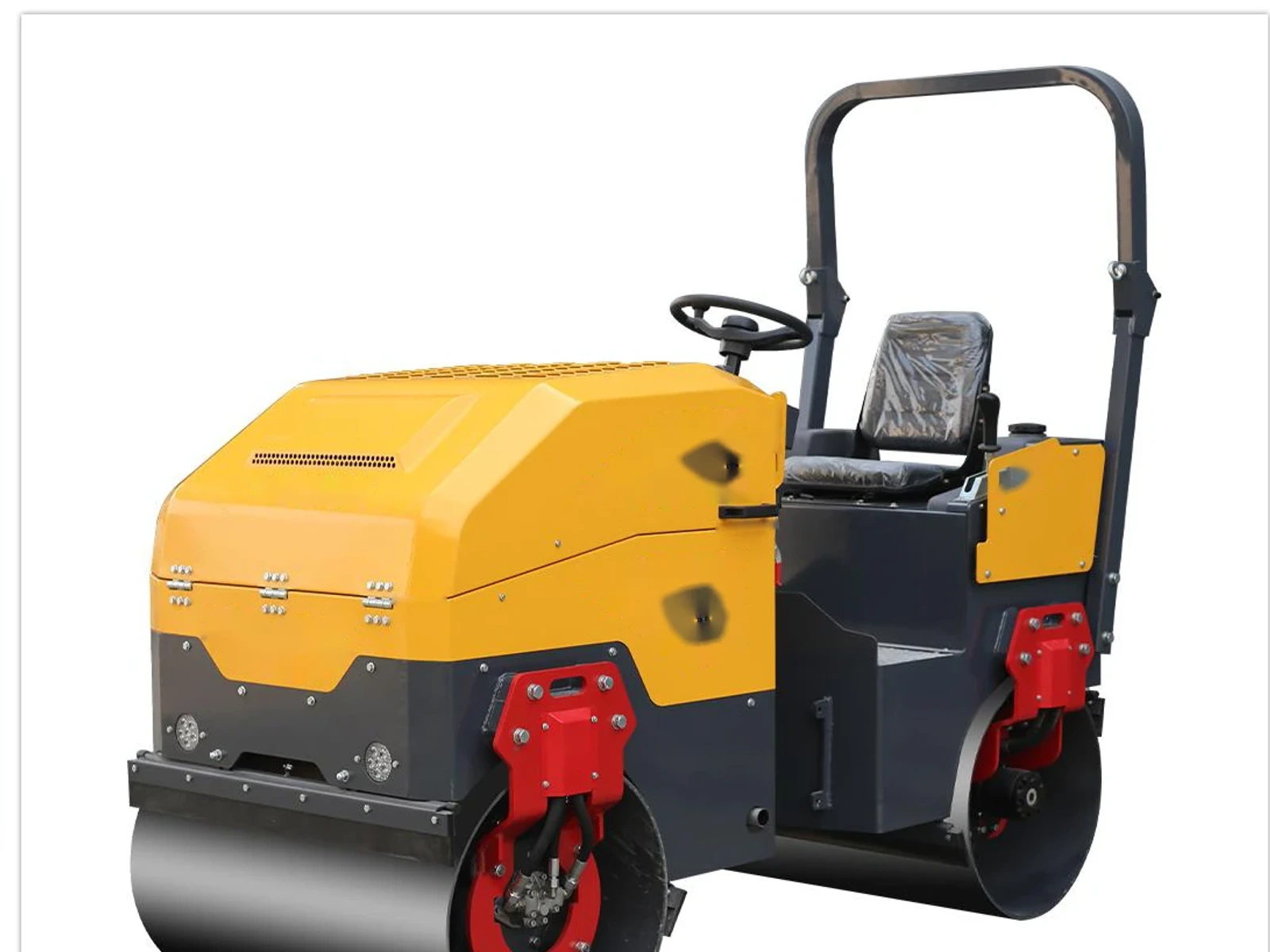 2-Ton Fully Hydraulic Tandem Road Roller TC-JS1000
2-ton fully hydraulic tandem vibratory roller, mainly used for vibratory compaction of water-stabilised base courses, lime soil, sand & gravel, asphalt pavement and pipe-trench backfill.
View Product →
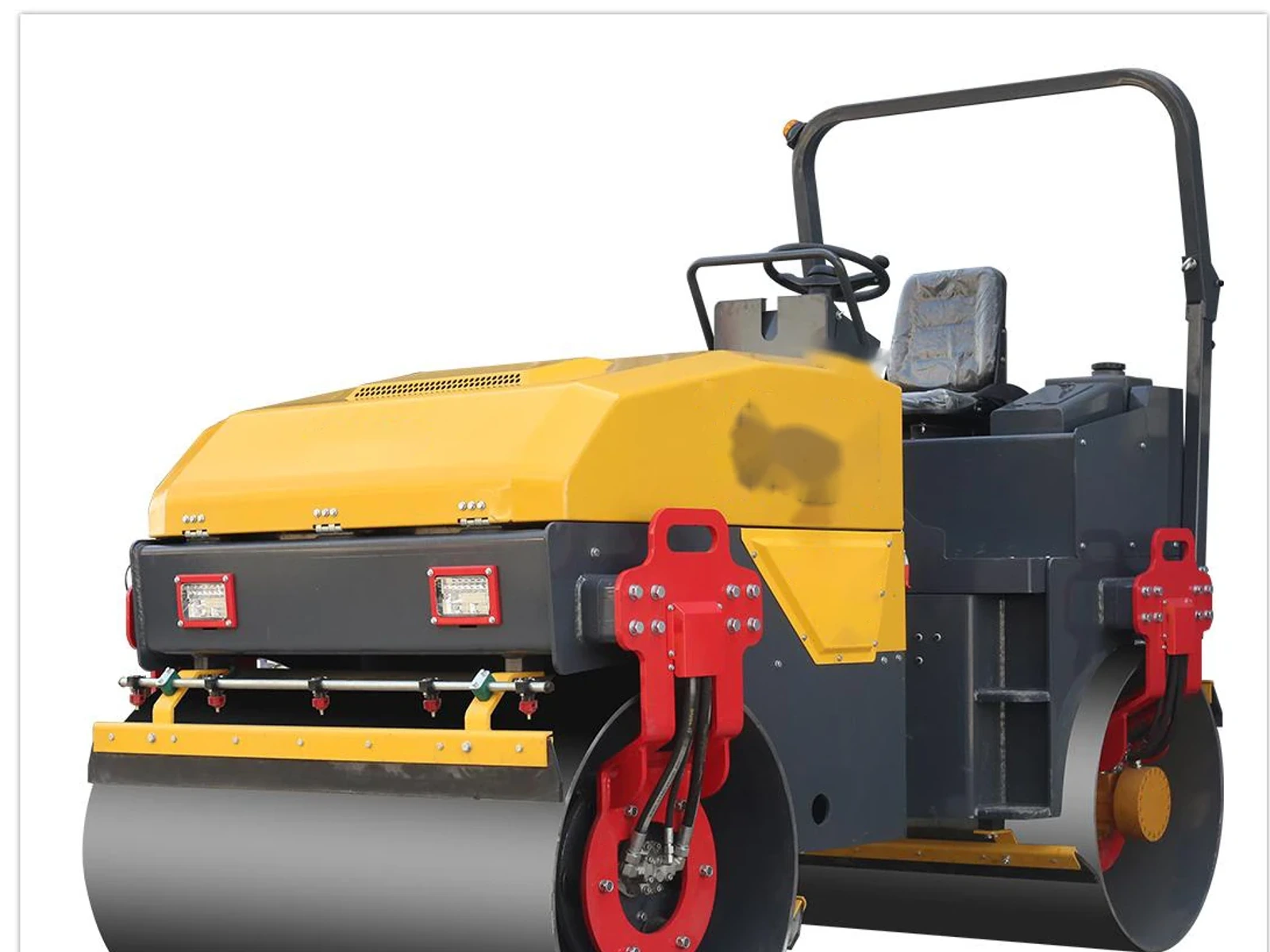 4-Ton Fully Hydraulic Tandem Road Roller TC-JS1400
Changchai 490 diesel engine — excellent performance and strong power.
View Product →