Road Roller Operating Weight vs Centrifugal Force: How to Read the Specifications
Compare road roller operating weight, centrifugal force and static linear load by checking units, configuration and per-drum ratings before ranking quotes.

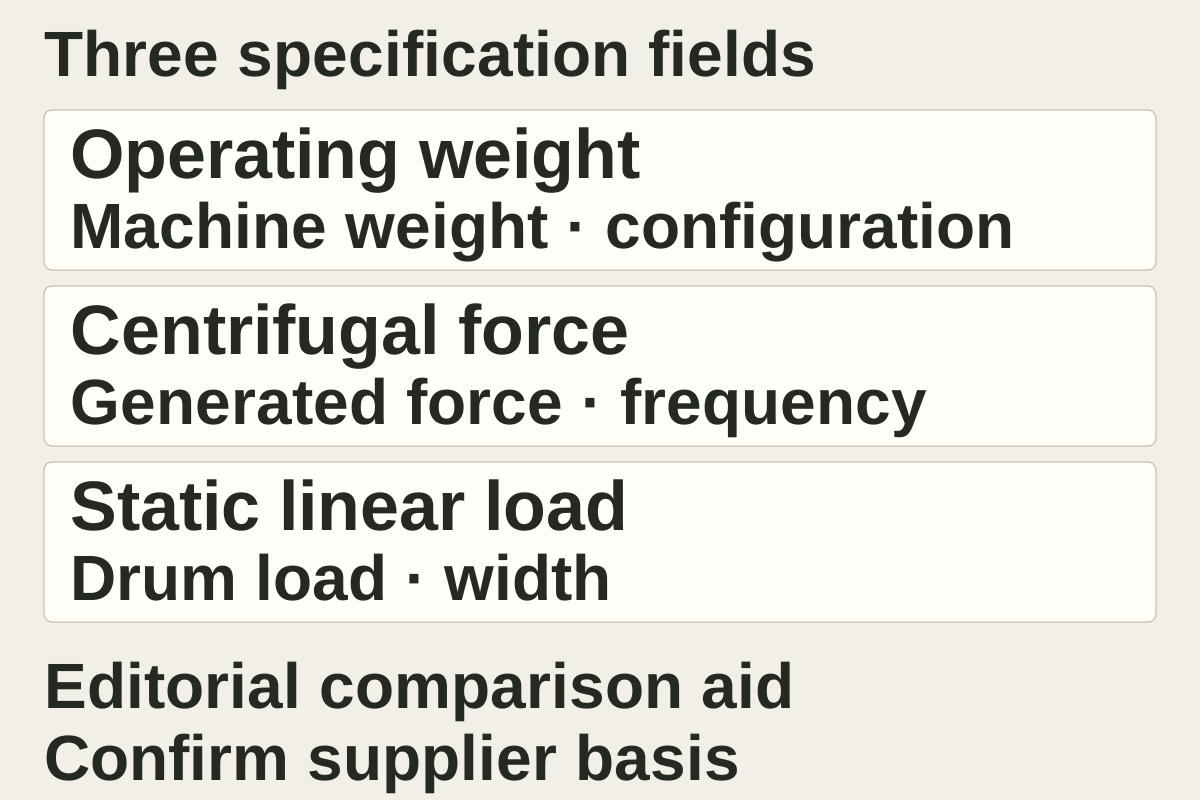
Road roller operating weight and centrifugal force describe different things. Operating weight states the machine's weight in a declared configuration; centrifugal force rates force generated by its vibration mechanism at a stated frequency. Static linear load adds another basis: static drum load relative to drum width. Keep these fields separate, then check units, configuration and whether a rating applies to one drum or the whole machine before comparing quotes.
Metric comparison
| Specification | What the field tells you | What to confirm before comparing |
|---|---|---|
| Operating weight | Machine weight under the supplier's stated operating configuration | Fuel, water, operator, ballast and fitted equipment included |
| Centrifugal force | Generated-force rating of the vibration mechanism at a stated frequency | Unit, stated frequency, vibrating drums and per-drum or total basis |
| Static linear load | Static load referenced to drum width | Front or rear drum, load unit, width basis and configuration |
These are separate specification rows. A larger number in one row does not answer an unknown question in another.
Three metrics that answer different questions
A comparison sheet may put operating weight beside centrifugal force, making the two numbers look like alternative measures of the same capability. Start by reading their labels rather than ranking their size. A kilogram weight entry and a kilonewton force entry belong to different quantities; adding the displayed numbers or treating them as interchangeable would erase that distinction.
The AEM 1994 Vibratory Roller Handbook is useful reporting guidance. Its recommended specification list separates operating weight, shipping weight, static weight at drums or tires, and centrifugal force at a stated frequency. The definitions identify centrifugal force as force generated by the vibration-inducing mechanism. These are attributed historical definitions, rather than proof that every current supplier follows the same convention.
The handbook also distinguishes generated centrifugal force from dynamic force at the drum-material interface. It says the latter varies with the material's type and condition and does not recommend it for rating compactors. A quoted centrifugal-force value therefore does not establish the force acting at the interface or prove a particular compaction depth, density or pass count.
Terminology deserves the same attention as units. The “Amplitude, frequency collide” section of Roads & Bridges’ Cracking the compactor code article describes centrifugal force as energy and uses foot-pounds. That wording conflicts with the handbook's advice against describing centrifugal force as energy or with a time or travel-distance factor. When a quote uses an energy or "total applied force" label, ask what is being measured and how it was defined before placing it beside a centrifugal-force rating.
For mechanism and material-selection context, use the separate guide to static and vibratory rollers. This specification-reading guide does not choose vibration settings or substitute for a job-specific compaction assessment.
Check the operating-weight configuration
"Operating weight" is only comparable when the included configuration is known. A label alone may not tell you whether a supplier included an operator, fuel, sprinkler water, optional equipment or ballast. Keep that uncertainty in the comparison record instead of assuming the heavier figure represents the same configuration.
The 1994 handbook gives one explicit convention: filled mechanical operating systems, full fuel, half a sprinkler tank where fitted and a 75 kg operator. It also calls for ballast location, type and weight to be stated. This is a historical reporting example. It is not a declaration of the configuration used in a current TerraCub sheet or another manufacturer's quote.
| Configuration field | Entry to request | If the sheet is silent |
|---|---|---|
| Machine identity | Exact model and supplied configuration | Keep model/configuration unresolved |
| Fuel and operating systems | Fill condition used for the rating | Record "not declared" |
| Sprinkler water | Tank fitted and water quantity included | Ask whether the quoted weight includes water |
| Operator | Included or excluded; stated allowance if included | Do not assume an operator allowance |
| Ballast and options | Type, amount, location and fitted equipment | Request the rating for the proposed configuration |
Shipping weight should remain a separate row. The handbook lists it separately from operating weight; neither label should silently replace the other when filling a quote-comparison worksheet.
Read the drum and width basis
Once the units and configuration are recorded, check which part of the roller the value describes. The handbook says that where more than one drum vibrates, weight and force specifications should be supplied for each drum. A current sheet still needs to declare whether its force number refers to one vibrating drum, both drums or another stated basis.
Static linear load needs its own check. The handbook defines linear static force using static weight divided by drum width, and linear centrifugal force using centrifugal force generated per drum divided by drum width. Its historical weight-unit conventions should not be silently mixed with a present force-per-width label. Read the unit and drum identity together; confirm a common basis before doing a numerical comparison.
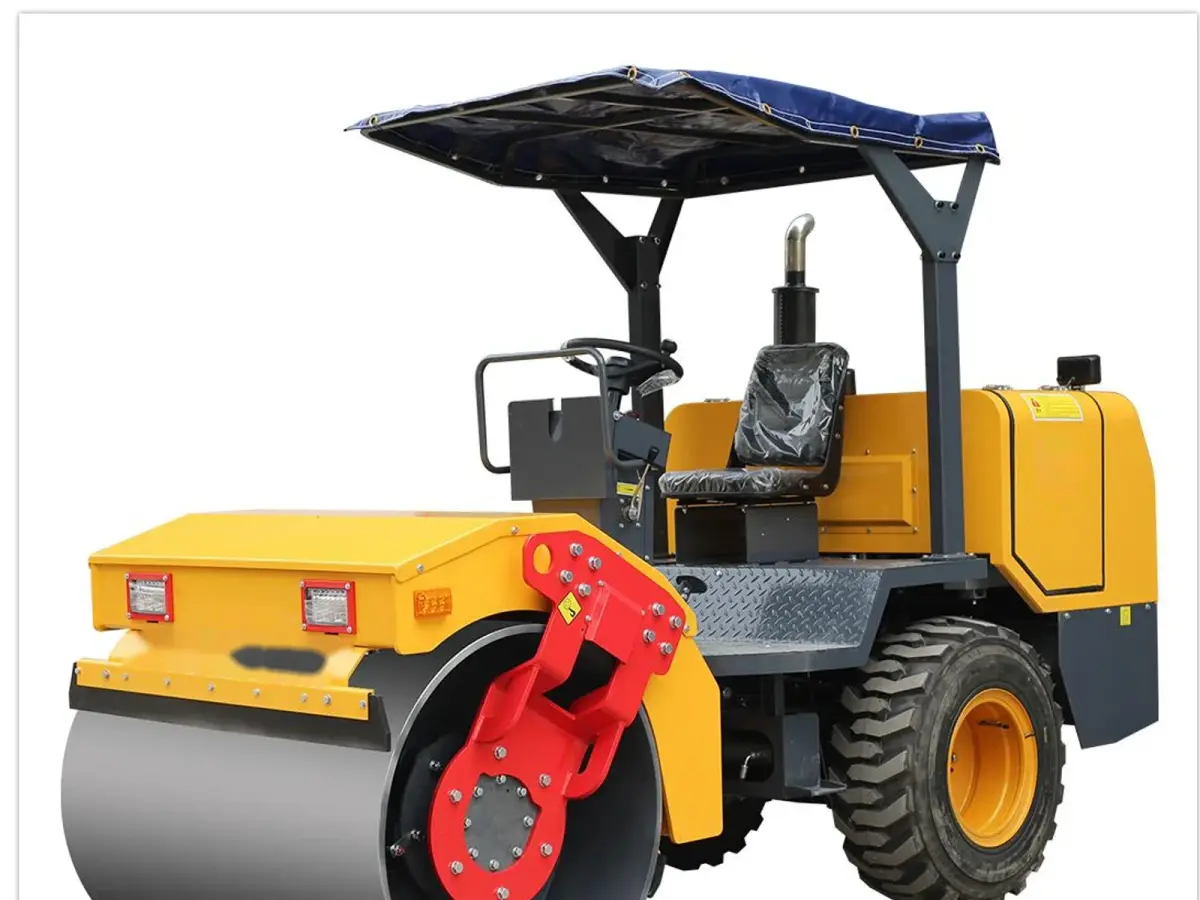
Front and rear values are useful clues. The current TerraCub TC-JSY700 catalog labels static linear load as 77/56 N/cm for front/rear, while its exciting-force field lists 30 kN. These are observations of catalog labels, not a verified comparison of performance. The catalog does not establish here whether that force number is per drum or a machine total, nor the fill condition or test method behind it. Carry those unknowns into the supplier enquiry rather than filling them from the front/rear load values.
Build a comparison worksheet
Use one row per metric and one column per quoted machine. Keep the supplier's original wording and units alongside any later confirmed comparison basis. An empty basis field is a question to resolve, not permission to rank the available numbers.
| Worksheet field | Quote A | Quote B | Comparison action |
|---|---|---|---|
| Model/configuration and sheet revision | Record exact identity | Record exact identity | Confirm the ratings apply to the proposed machines |
| Operating weight and unit | Copy value and label | Copy value and label | Match included operating configuration |
| Fuel/water/operator/ballast basis | Declared details or unknown | Declared details or unknown | Ask for missing conditions |
| Centrifugal-force label and unit | Copy value and label | Copy value and label | Confirm generated-force definition |
| Frequency stated with force | Declared condition or unknown | Declared condition or unknown | Confirm the condition; do not invent a setting |
| Force drum basis | Per drum, total or unknown | Per drum, total or unknown | Obtain a matching declared basis |
| Static linear load | Separate front/rear fields and units | Separate front/rear fields and units | Match drum, width and configuration basis |
| Source and unresolved fields | Sheet/revision and questions | Sheet/revision and questions | Keep unresolved rows out of numerical ranking |
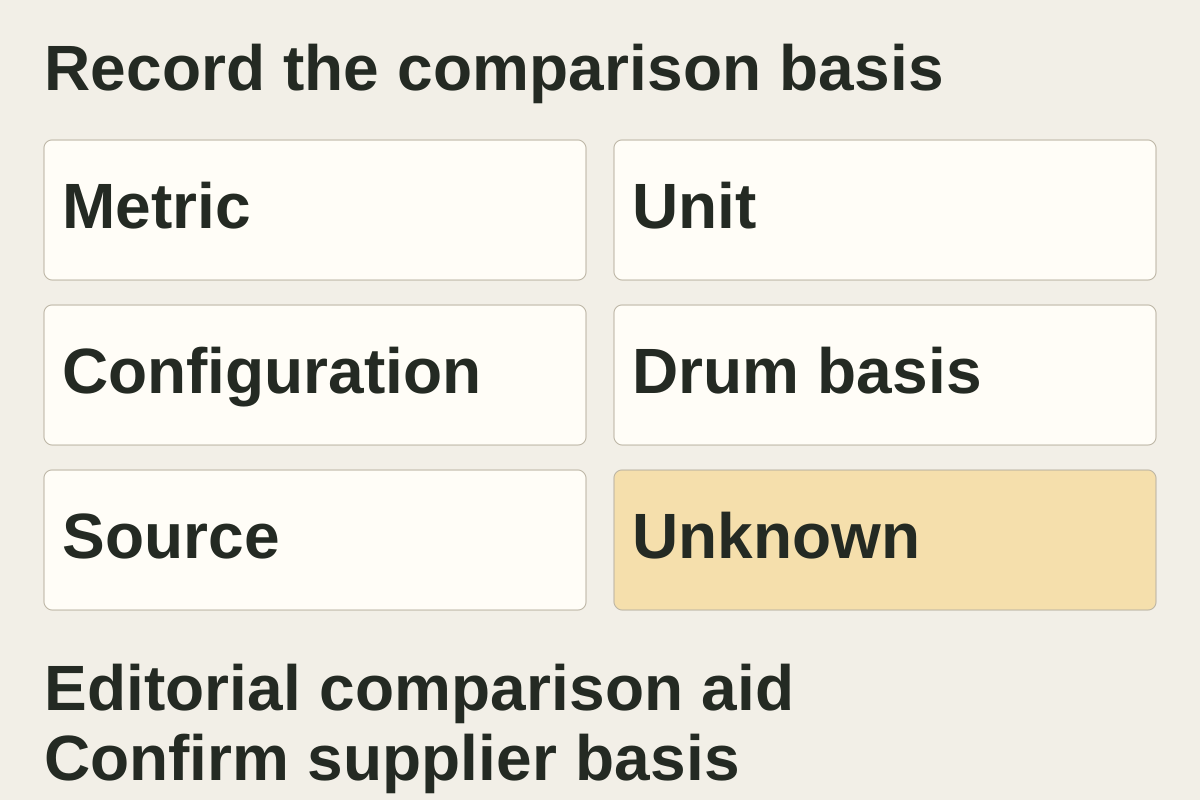
This method helps organize an enquiry; it does not calculate a compaction result or nominate the best roller for a job. Keep the commercial quote scope separate from these technical fields.
Ask for the missing specification basis
Send the supplier the exact sheet or revision and identify the unresolved fields. A useful request might read: "Please confirm the operating-weight configuration, the centrifugal-force unit and stated frequency, whether that force is per vibrating drum or total, and the front/rear static-linear-load basis for this model."
Include the fitted configuration you intend to buy. Ask for clarification of the existing ratings before requesting a higher number. This keeps the response tied to the machine and the comparison decision rather than a general promise of stronger compaction.
For TerraCub mini road rollers, prepare those fields and request the specification basis. The next step is a model-specific enquiry about the available documentation and undeclared conditions; this guide does not promise a compaction outcome or confirm an unreported force basis.
FAQs
Is road roller operating weight the same as centrifugal force?
No. The AEM 1994 handbook lists operating weight separately from centrifugal force and defines the latter as force generated by the vibration mechanism at a stated frequency. Read each value with its unit and declared basis; do not treat the two numbers as interchangeable ratings.
Does a centrifugal-force rating apply to each drum or the whole roller?
The sheet must tell you. The historical AEM guidance calls for weight and force specifications for each drum when more than one drum vibrates. A force label in a current catalog does not establish that basis by itself; ask the supplier whether it is per drum or total.
Why does static linear load need a separate front and rear comparison?
It references load to drum width, so drum identity and the stated unit matter. The current TC-JSY700 catalog gives separate front/rear labels. Keep them separate and ask for their configuration and width basis before comparing them with another machine or with a generated-force rating.
Does operating weight include the operator, fuel, water and ballast?
Confirm the supplier's convention. The AEM 1994 example includes a 75 kg operator, full fuel and half a sprinkler tank where fitted, with ballast details declared. That historical example does not establish the basis of every current quote or TerraCub specification.
Source and limitation notes
The technical definitions and reporting examples come from the Vibratory Roller Handbook, second edition, copyright 1994, credited to AEM's CPMTC/BAEB. Relevant locations are PDF page 11/printed page 9, pages 14–15/printed pages 12–13, and page 16/printed page 14. The reviewed copy is a supplier-hosted mirror of the original document. Historical definitions are attributed explicitly; current supplier conventions remain subject to confirmation.
Catalog numbers are label observations from the current TC-JSY700 specification fields. No numerical conversion, vibration formula, compaction setting, test result or performance guarantee is supplied.