Radial Lift vs Vertical Lift Skid Steer: Compare Reach Before You Buy
Compare radial and vertical lift by midrange and full-height reach. Check the exact model and attachment evidence before shortlisting a skid steer.

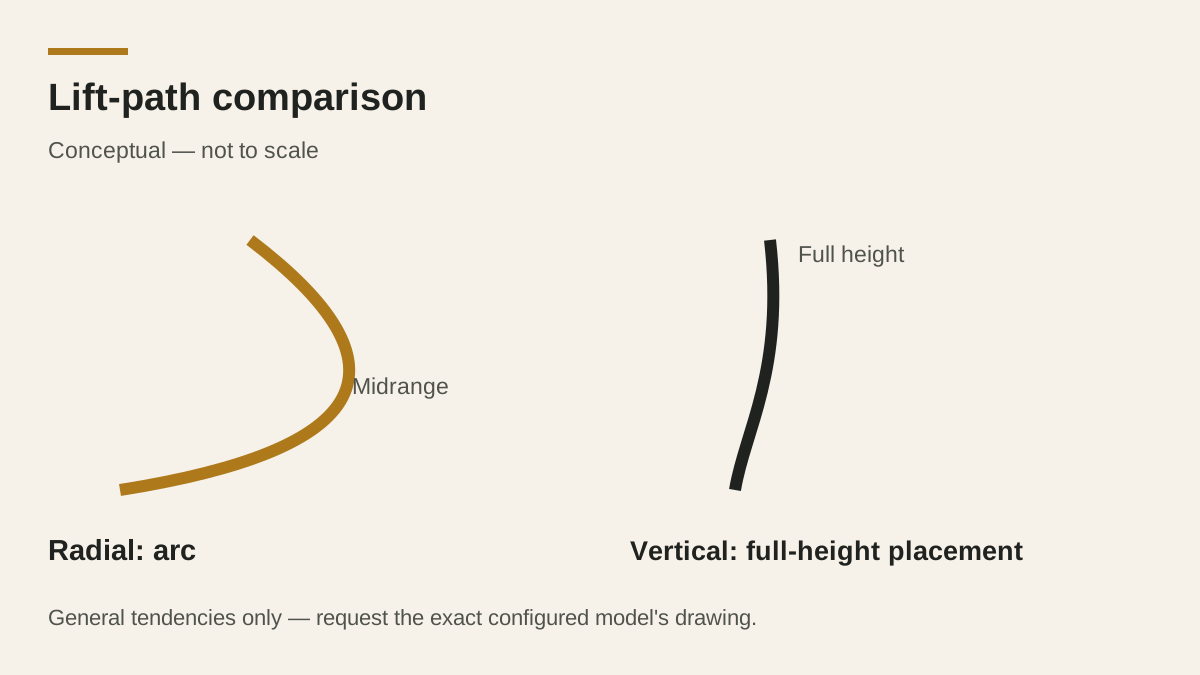
Direct answer: Radial lift follows an arc and typically offers useful forward reach around the middle of the lift range. Vertical lift configurations generally favor reach and material placement at full height. The better choice depends on where your work needs that reach. Compare the exact loader and attachment at the relevant lift stage before choosing; neither label establishes an approved load or a complete machine fit.
Start with the lift stage your work uses most
A buyer who spends most of the day handling material around the middle of the lift cycle has a different comparison to make from one who frequently places material near full lift. Begin with that distinction. Describe the repeated movement, identify the stage at which forward reach matters, and then compare machines at that stage.
For example, a job description such as “move loose material” leaves too much open. “Most placement happens around mid lift, with occasional higher placement” gives a supplier a useful starting point. It still needs a model-specific drawing or other identified reach evidence before it becomes a supported configuration choice.
Lift path is also a separate buying dimension from wheel or track choice and operator format. A compact stand-on loader does not acquire a particular lift path simply because it is small. Keep those broader choices in the mini skid-steer selection guide separate from the arm-path comparison here.
What radial and vertical lift actually tell you
In its lift-arm comparison, CASE describes a radial path as similar to an arc, with greater reach at mid ranges. It describes vertical configurations as generally offering greater reach at full height. Toro's compact-loader guidance makes the same midrange-versus-full-height distinction, while the ASV loader overview associates vertical designs with elevated material placement.
These are useful design tendencies for forming a shortlist. They do not supply a reach curve for a TerraCub model or establish that every vertical machine reaches farther than every radial machine.
| Comparison | Radial lift | Vertical lift | What the buyer still needs |
|---|---|---|---|
| General path description | An arc | A configuration favoring elevated placement | The exact model's path drawing |
| Reach emphasis in the selected OEM guidance | Around mid lift | At full lift | Evidence at the stage used by the job |
| Shortlist question | Does this model provide the required midrange position? | Does this model provide the required full-height position? | Matching attachment and comparison position |
| What the label cannot settle | Approved load, attachment suitability or exact fit | Approved load, attachment suitability or exact fit | Applicable model and attachment documentation |
The word “vertical” should not be read as a promise of a mathematically straight path or unchanged horizontal reach through the entire cycle. Likewise, a radial label does not reveal the amount of reach at every height. The model drawing is the next piece of evidence.
Compare reach at low, middle and full lift
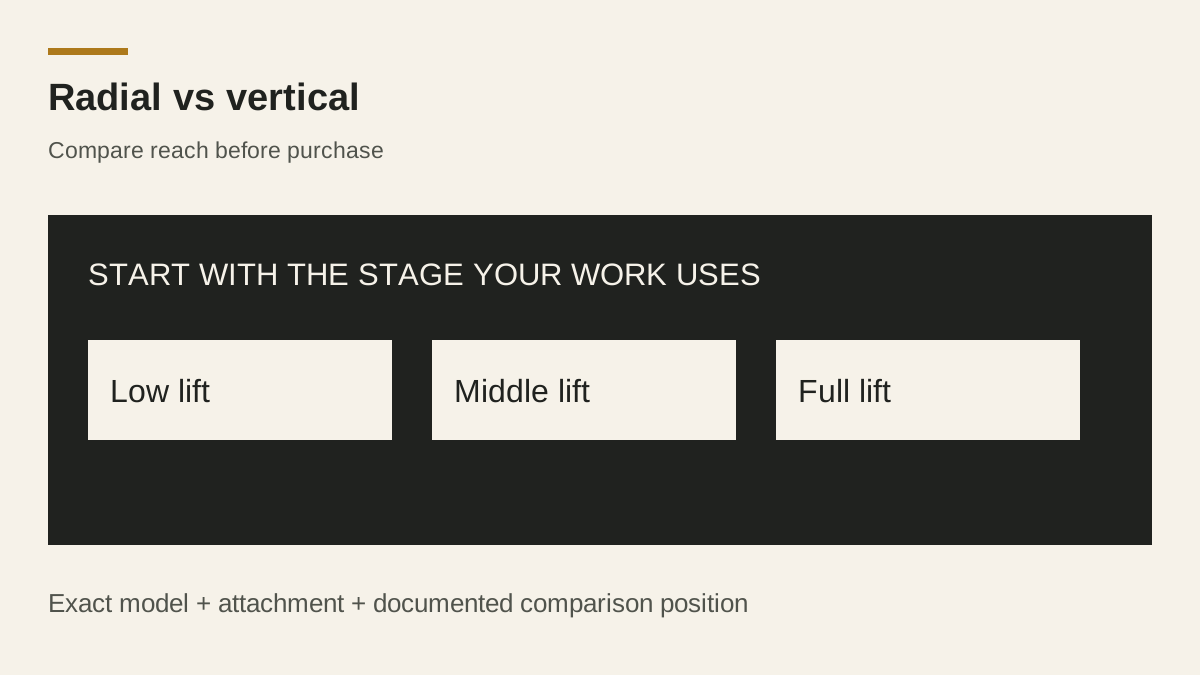
Use three comparison positions to keep a supplier discussion concrete: low lift, the middle stage used by the work, and full lift. The purpose is to identify which positions are documented and which remain unanswered. These are comparison stages, not universal numerical height definitions.
Start with the dominant stage. If most placement happens at mid lift, request the model's evidence for that position before relying on a full-height specification. If full-height placement drives the purchase, examine the corresponding evidence first. Then check whether the other stages needed by the job are covered.
| Lift stage | Question to ask | Evidence to retain |
|---|---|---|
| Low | What configured-machine path information is available near the start of the cycle? | Identified drawing or documented comparison position |
| Middle | What forward position is shown at the middle stage relevant to the work? | Model and attachment evidence for that position |
| Full | What forward position is shown at full lift? | Evidence explicitly identified as full lift |
A full-height reach figure should stay attached to its stated position. Moving that number into the middle row would fill an unknown with an assumption. Where the supplier's material does not show the required stage, leave it marked “not confirmed” and ask for the missing evidence.
This comparison helps decide which configuration deserves closer review. It does not calculate receiving-edge clearance, explain competing height labels or replace an exact job-fit assessment.
Ask for a comparison of the same configuration
An arm-path comparison becomes much more useful when both records identify the machine and attachment. A drawing for another model, or a position shown with a different attachment, may answer a different question from the one in the enquiry.
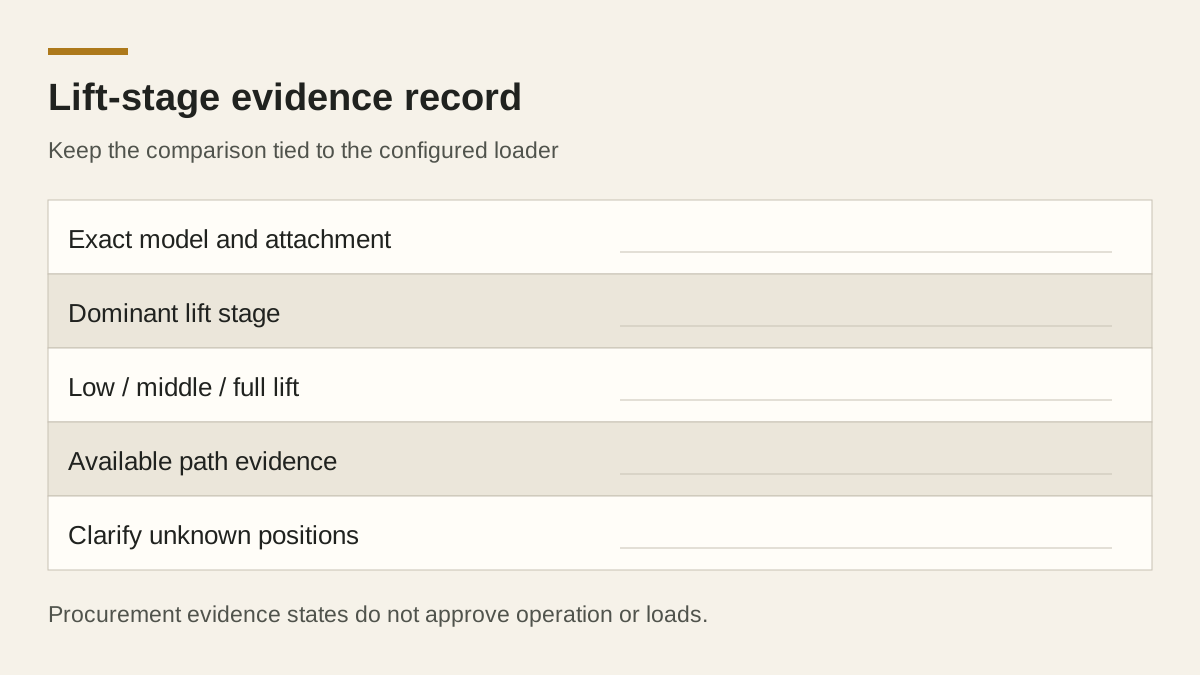
Send a short evidence request containing the exact model, the intended attachment, the lift stage that dominates the work and the positions still unknown. Ask the supplier to identify the applicable drawing or documented reach information. If the answer uses another configuration, ask what can be confirmed for the shortlisted one.
A compact enquiry could read:
We are comparing radial and vertical lift for work concentrated around mid lift, with occasional full-height placement. Please identify the lift-path evidence for the quoted model and attachment at those positions, and mark any position that is not documented. Please also identify the applicable capacity and attachment information separately.
That request preserves the basis of the comparison without inventing a reach value. It also makes it easier to compare two replies: both must answer the same configuration and stage questions.
Keep capacity and attachment ratings separate
Reach is one part of the buying decision. A lift-path label alone does not establish the approved load for the intended task, and a general OEM design comparison is not a capacity rating for another manufacturer's loader.
Request the applicable machine and attachment information alongside the path evidence. Keep the reach comparison and the rating basis as separate records so that a favorable arm position does not become an assumed load approval.
This matters particularly when the shortlisted machine will use more than one attachment. Confirm which attachment each piece of evidence describes. Do not infer fork behavior, self-leveling, stability or an attachment's capability from the words “vertical lift.” Those questions need their own applicable documentation.
What current TerraCub data can confirm
The current TerraCub catalogue explicitly lists the V1000's lift as Vertical. The S370 summary also describes vertical lift action. These statements support catalogue identification; they do not provide complete trajectories or establish reach with every attachment.
The TerraCub skid-steer loader range is the commercial starting point for a real shortlist. The V1000 product page lets buyers inspect that model's catalogue information, then carry unresolved path questions into a configuration enquiry.
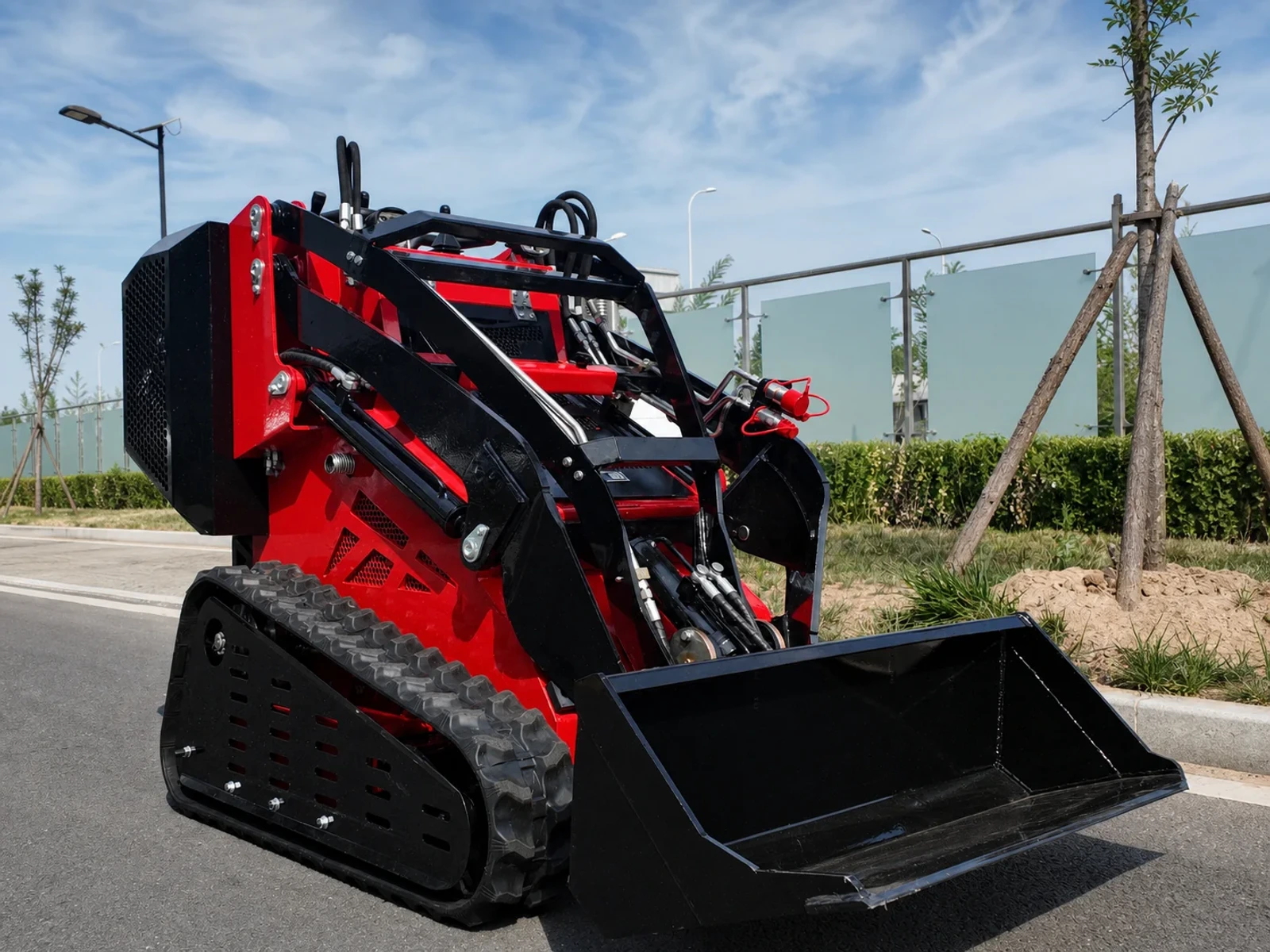
For other models, keep the lift path unconfirmed unless the relevant model documentation states it. A photograph is not a substitute for that evidence. In particular, “radial” in a piston-motor description names a motor characteristic; it does not identify a radial loader-arm path.
| Catalogue statement | Supported conclusion | Remaining question |
|---|---|---|
| V1000: Lift listed as Vertical | The catalogue identifies a vertical-lift configuration | What does the configured model's path evidence show at the required stages? |
| S370: summary describes vertical lift action | The summary positions that model as vertical lift | Which model-specific drawing supports the comparison? |
| No explicit model lift-path statement | The path remains unconfirmed | Can the supplier identify the applicable lift design? |
Turn lift-path evidence into a shortlist
Use Accept, Clarify and Reject as procurement evidence states. They describe whether a comparison is usable for the shortlist. They are not permission to operate the machine or a safety verdict.
| State | When to use it | Next action |
|---|---|---|
| Accept | The evidence identifies the quoted model and attachment and answers the required comparison position | Retain it with the shortlist; continue the separate rating and job-fit checks |
| Clarify | A required stage, model identity or attachment basis is missing | Ask for that specific missing information |
| Reject | The offered comparison substitutes a different model or lift stage as proof for this one | Replace the comparison with applicable evidence before relying on it |
For a hypothetical mid-lift placement task, a supplier's full-height figure leaves the dominant stage at Clarify. It does not prove the machine unsuitable, and it does not prove it suitable. Once applicable mid-lift evidence arrives, the comparison can be assessed on its stated basis.
Prepare a configuration enquiry
Bring the exact loader shortlist, intended attachment, dominant lift-cycle stage and available path evidence to a configuration enquiry. Mark the comparison positions still unknown so the discussion starts with the missing information.
A useful shortlist connects the design tendency to the configured machine's evidence. Radial or vertical is the starting description; documented reach at the stage used by the work is what makes the comparison useful.
FAQs
What is the main difference between radial and vertical lift?
Radial lift follows an arc and typically emphasizes forward reach around mid lift. Vertical configurations generally favor reach and placement at full height. The exact model and attachment evidence should confirm the positions relevant to the job.
Is vertical lift always the better skid-steer choice?
No. A midrange-reach task and a full-height-placement task call for different comparisons. The lift label also does not establish approved load or attachment capability. Choose a shortlist using applicable configuration evidence and keep those rating questions separate.
Sources used in this guide
The general path comparison uses CASE's “Loader Arm: Radial vs. Vertical” section, Toro's “Radial Lift vs. Vertical Lift” section and ASV's “Faster Load Cycles” section, linked above. Their statements remain scoped manufacturer guidance. TerraCub catalogue labels are model identifications, with no original field tests or measured trajectory charts claimed here.
Recommended Products
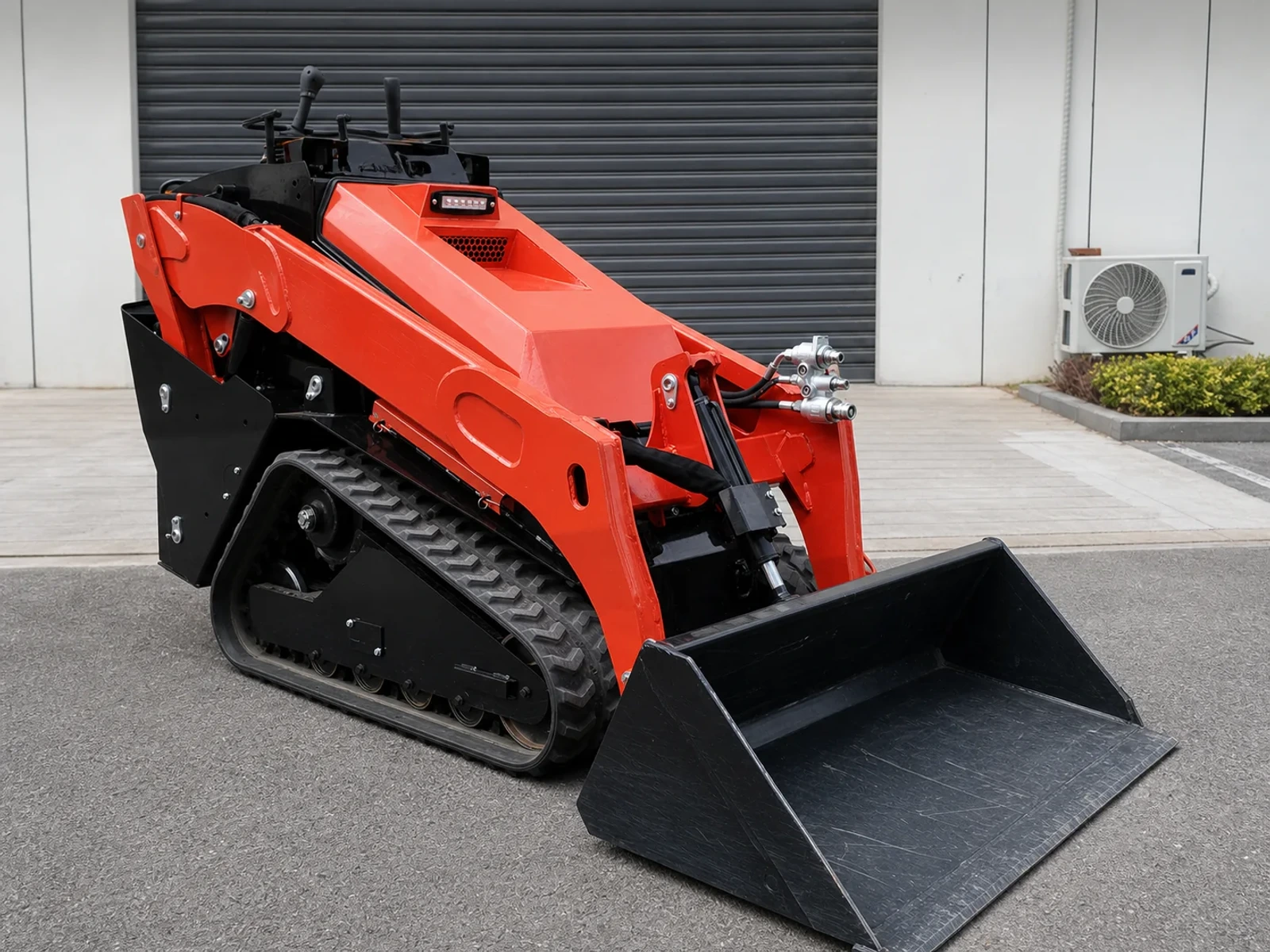 Compact Track Skid Steer Loader V1000
Compact track loader with 500 kg rated load, vertical lift positioning, and heavier-duty contractor-oriented stance.
View Product →
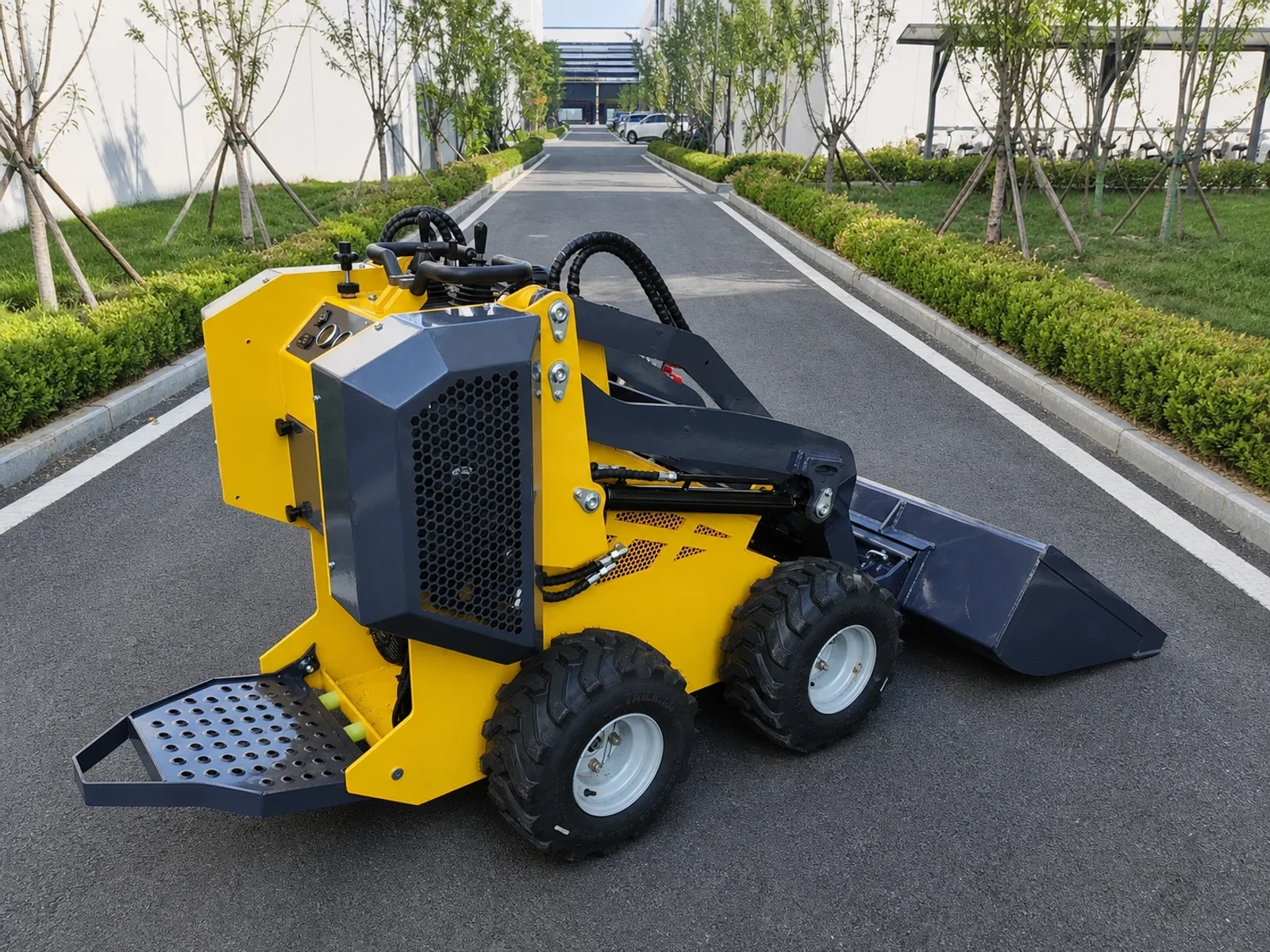 Mini Skid Steer S370
Wheeled loader with 0.07 m3 bucket, easy-control positioning, and higher travel speed for small-site work.
View Product →