Mini Skid Steer Maintenance: The First 100 Hours
Build the first-100-hour maintenance plan from the exact Operation and Maintenance Manual for the machine, engine, undercarriage and attachments. Record every inspection, service event, defect and closeout; never borrow intervals or values from a similar model.

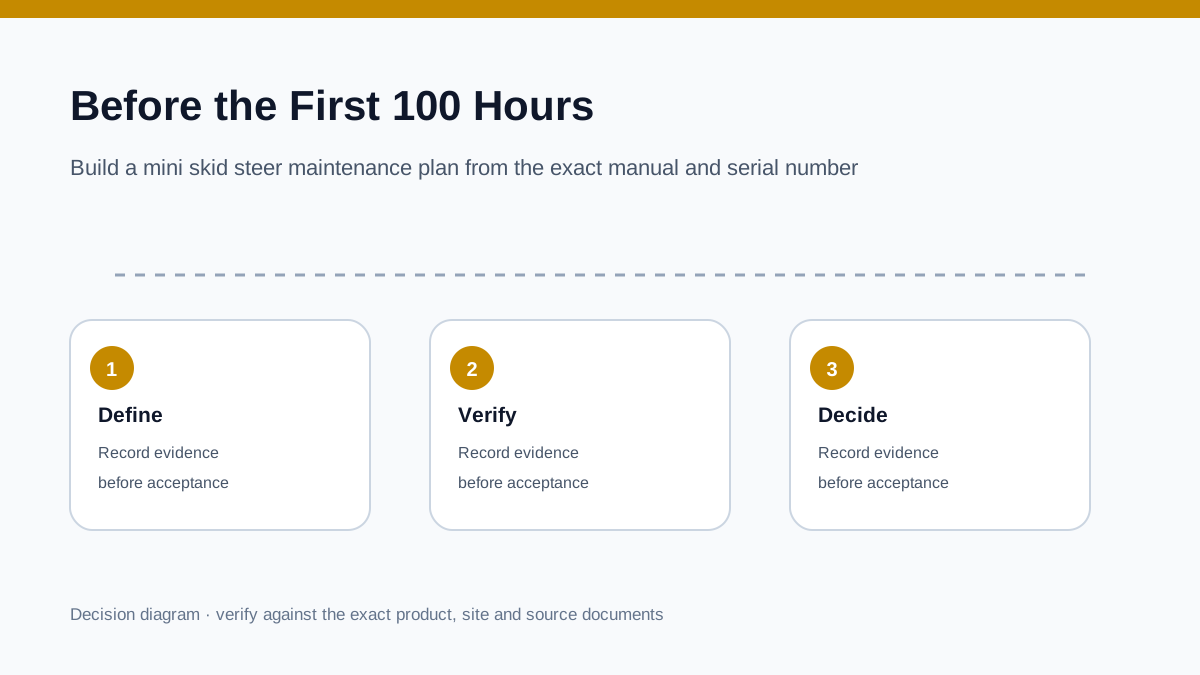
Direct answer: Build the first-100-hour maintenance plan from the exact Operation and Maintenance Manual for the machine, engine, undercarriage and attachments. Record every inspection, service event, defect and closeout; never borrow intervals or values from a similar model.
1. Start the maintenance plan before delivery
When you shortlist a machine from the TerraCub mini skid steer range, ask for the exact machine model, serial number, engine identity, configuration, manuals, service schedule, recommended fluids and filters, warranty conditions and parts contact before shipment.
Confirm that the manual matches the actual engine, auxiliary hydraulic system, undercarriage or tire setup and attachment interface.
Use one equipment record for machine, engine and attachments.
Values such as tire pressure, wheel-nut torque, track deflection and service intervals are published per model. Bobcat lists its loader service schedules by model and serial-number prefix, and its track loader guide points to each model’s Operation and Maintenance Manual for the correct track deflection range. A generic brochure or a similar model’s manual cannot stand in for those values.
2. Build a daily pre-start walk-around
Bobcat’s current loader maintenance guide lists daily checks for fluid leaks (including hydraulic lines), tire inflation or track tension, attachment couplers and whether the attachment locks securely, drive motors, belts, and engine oil, hydraulic oil and coolant levels. The daily list in its S185 skid-steer manual adds the seat belt, seat bar and control interlocks, the interlock control system, horn and back-up alarm, cooling-system damage or leaks, and loose or broken parts.
Use those lists as category prompts, then replace every action and limit with the exact TerraCub manual.
Daily records should cover visible leaks and loose hardware; fluid indications; cooling passages and debris; tire condition/pressure or track condition/tension evidence; rollers, sprockets and idlers where applicable; attachment locking, pins, hoses and couplers; controls, alarms and interlocks; and new noise, vibration, heat, smoke or performance change.
Do not operate when a safety device, attachment lock, hydraulic hose, structure or control does not pass the manual-based check. The S185 manual states that the loader and attachment must be in good operating condition before use, that the attachment wedges must extend through the mounting frame or the attachment can come off, and that the dealer must be contacted if the interlock system does not deactivate the lift, tilt and traction functions. On US construction sites, OSHA 29 CFR 1926.20(b)(3) prohibits using non-compliant equipment and requires it to be tagged, locked out or removed from its place of operation.
3. Convert the manual schedule into a service calendar
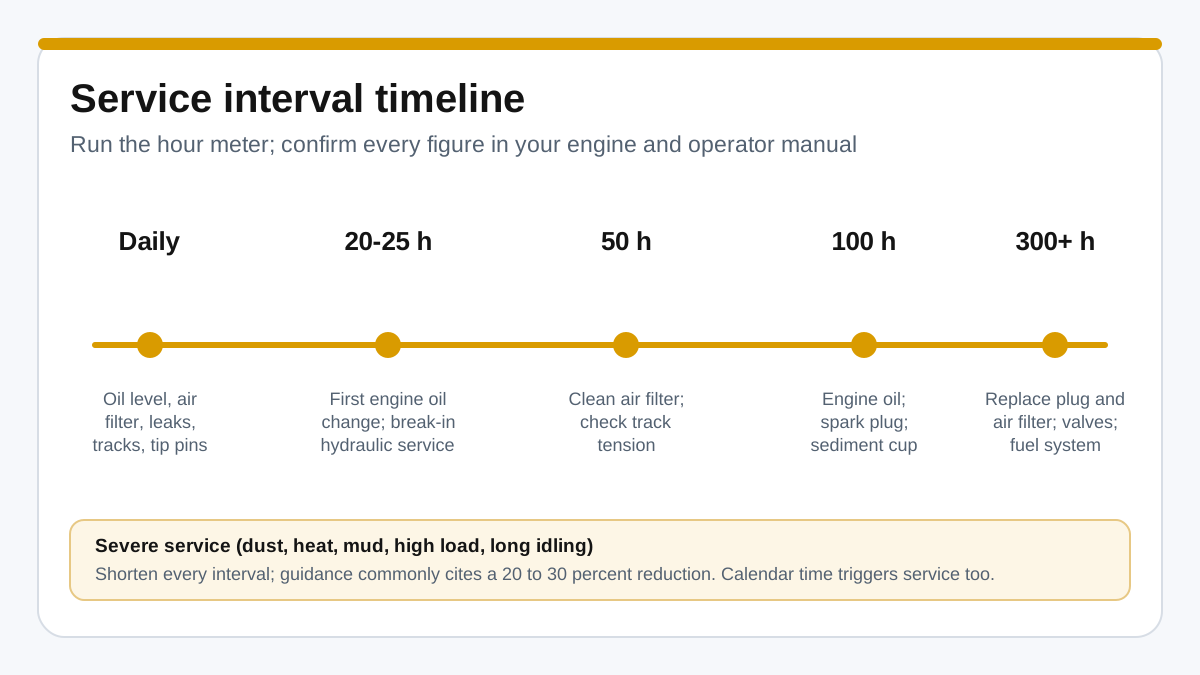
List each task with the manual’s hour and calendar triggers.
Add the consumable, specification, quantity, safe access procedure, responsible person and completion proof.
Do not use a “first 50 hours” or “100 hours” milestone merely because another brand publishes it. Bobcat’s S185 schedule, for example, sets some items at the first 50 hours, others at the first 500 hours, and a 100-hour oil and filter change only under severe conditions; those points belong to that model.
An open defect remains open until the correction and a post-service function check are documented. The same manual tells technicians to check for correct function after adjustments, repairs or service.
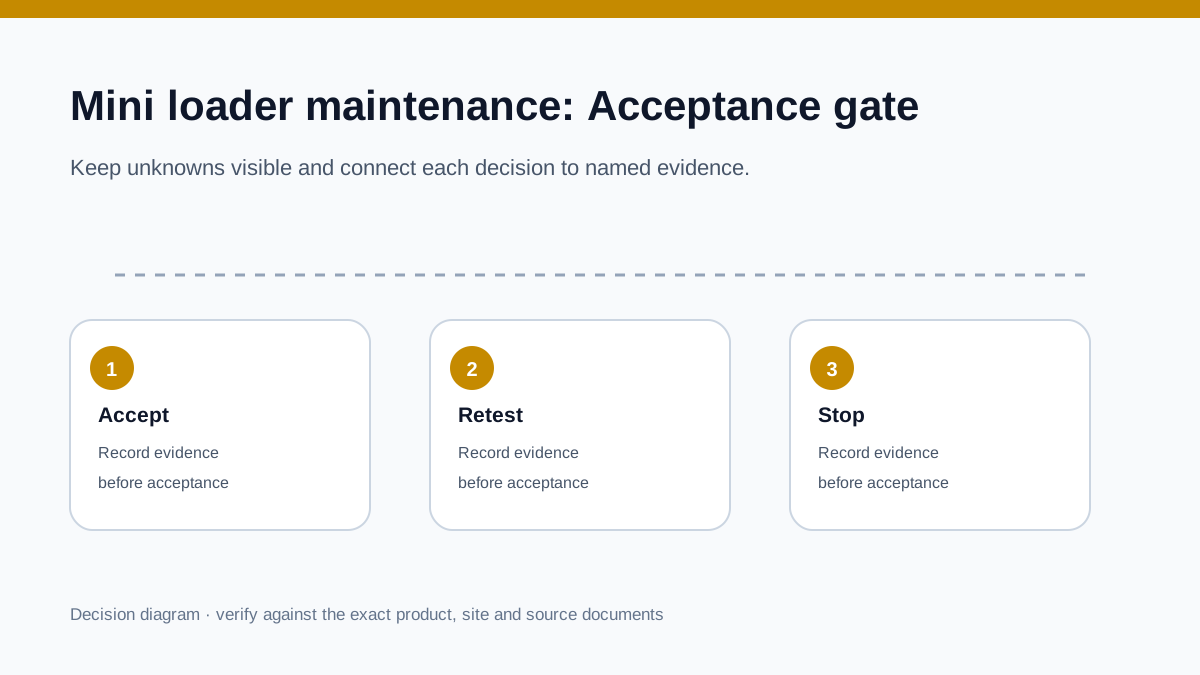
4. Protect cooling and hydraulics from the jobsite
Fine demolition debris, wet clay and packed soil can change cooling and wear conditions quickly. Bobcat’s track loader guide describes a radiator core packing with fine debris from a demolition site, and packed material in the undercarriage altering effective track tension.
Record the environment and use the manual’s severe-service or cleaning guidance where applicable.
Clean only by an approved method with the attachment lowered, the engine stopped and the controls deactivated as the manual describes.
Check hydraulic hoses, tubelines and quick couplers for leaks, damage, cracking or wear, and repair or replace damaged parts as the manual directs.
Escaping high-pressure hydraulic fluid can penetrate skin. Never search for a leak with a hand: Bobcat’s manual says to use a piece of cardboard or wood, and the UK Health and Safety Executive lists searching for leaks with bare hands as an operator error. If fluid enters the skin, get immediate medical attention.
Release stored hydraulic pressure before hydraulic repair or maintenance, and follow the exact manual and qualified service procedure.
5. Treat tracks, tires and attachments as separate owners
If you are still choosing between tires and tracks, settle that first with the skid steer vs compact track loader comparison; the maintenance record differs for each.
For tracked machines, record track condition, tension against the manual’s deflection range, cleanout and undercarriage wear.
For wheeled machines, record exact tire size, condition and pressure requirements. The S185 manual ties correct tire pressure to avoiding excessive wear and loss of stability, and calls for same-size tires on each side.
For attachments, keep the attachment manufacturer’s inspection, lubrication, fastener, tooth/edge and hydraulic requirements beside the machine plan.
Changing tires, wheels, tracks, counterweights or attachments can change machine weight, rated operating capacity, stability and maintenance needs. In the S185 manual, over-tire tracks and counterweights change machine weight and capacity, longer buckets move the load center forward and reduce rated operating capacity, and only attachments approved for the model may be used.
Record the change and obtain manufacturer confirmation.
6. Prepare the first spare-parts pack
Base the pack on the manual and operating environment, not a universal kit.
Planning categories include filters, specified fluids and grease, approved wear parts, fuses, attachment teeth or cutting edges, and supplier-identified field-service seals or couplers.
Confirm every part number against the exact serial configuration.
7. Close service events with evidence
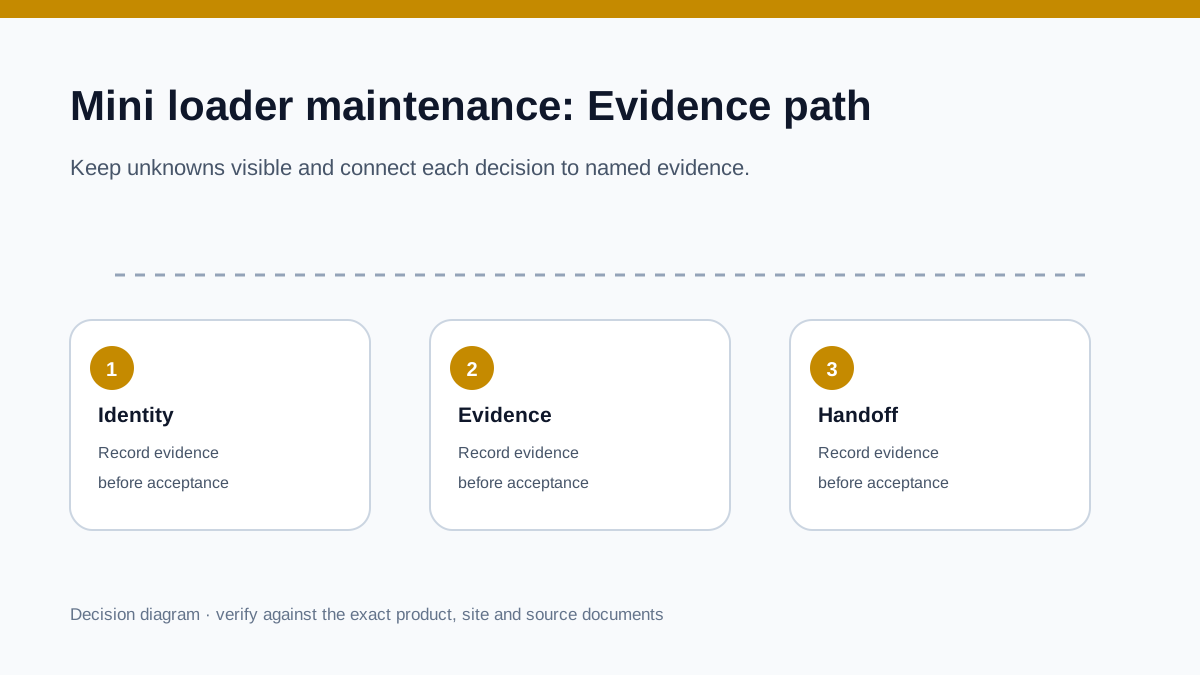
Log date, machine hours, condition, task, parts and fluids used, technician, measurements, photos, open defects and post-service functional check.
Records matter beyond the workshop. Bobcat’s European warranty guidance says service-related claims are assessed against the machine’s service record, and an incomplete or missing record can lead to coverage being denied. Check the equivalent requirement in the TerraCub warranty terms.
A completed box is not enough if it hides an unresolved defect.
FAQs
What maintenance should a mini skid steer receive every day?
Use the exact manual’s pre-start checklist. Manufacturer examples include leaks, fluid and coolant levels, tires or tracks, attachment couplers and locks, hoses, the seat bar and control interlocks, alarms, and loose or broken parts.
Is there a universal first-100-hour schedule?
No. Manufacturers publish schedules per model: Bobcat lists loader schedules by model and serial-number prefix, and its S185 manual mixes first-50-hour and first-500-hour items. Build the calendar from the manual supplied for the exact machine and engine.
How often should tracks be tensioned?
Check tension at the daily walk-around and adjust only to the deflection range in the model’s manual. Bobcat’s track loader guidance says an over-tight track stresses rollers and idlers, a loose track risks derailing, and packed material can change effective tension within a shift.
Which spare parts should be ordered with a new loader?
Start with manual-listed filters and consumables, then add approved wear parts and job-specific spares based on usage, lead time and local support. Confirm serial-level part numbers.
What records help with warranty and troubleshooting?
Keep machine/engine identity, service schedule, hour readings, inspection sheets, fluids and part numbers, photos, technician details, defects, corrections and post-service checks. Bobcat, for example, assesses service-related warranty claims against the machine’s service record.
Sources and scope
- Bobcat — Loader Service and Maintenance
- Bobcat — Loader Service Schedules
- Bobcat Europe — Compact Track Loader Maintenance: Service Intervals and Daily Checks
- Bobcat — S185 Skid-Steer Loader Operation & Maintenance Manual (6987011)
- HSE — High pressure fluid injection hazards
- HSENI — Safe working on vehicle hydraulic systems
- OSHA — 29 CFR 1926.20, General safety and health provisions
Bobcat documents are cited as manufacturer examples, not TerraCub specifications. Intervals, fluids, quantities, tension values, lifting points and torque requirements are model-specific. Follow the exact manual and qualified service guidance.
Build the parts and service brief with the machine
Send the exact model, serial/build data, operating environment, expected hours and attachment set so the maintenance and spare-parts plan can be reviewed.
Discuss the machine requirement