Petrol Mini Dumper Maintenance: A Service Schedule You Run on Two Clocks
One clock is a daily pre-use walkaround. The other is engine hours: a first service near 20 to 25 hours, then recurring work around 50, 100 and 300-plus hours. The engine follows its own manual; the drive, tracks and tip cylinder follow your dumper's operator manual.

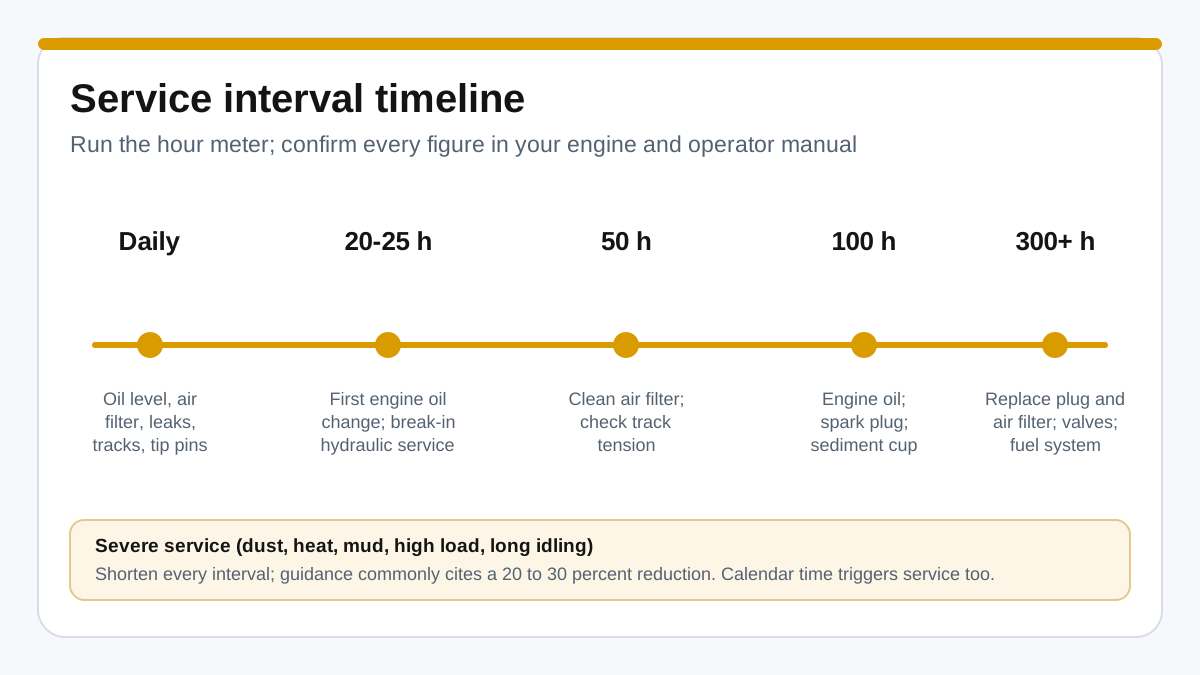
Direct answer: maintain a petrol (gasoline) mini dumper on two clocks at once. The first is a pre-use walkaround you do every day the machine runs. The second is a set of engine-hour intervals, typically a first service near 20 to 25 hours, then recurring work around 50, 100 and 300-plus hours. The small air-cooled engine follows its own manual (Honda GX-series figures are shown here as a common example), while the hydrostatic or gear-hydraulic drive, the rubber tracks or wheels, and the hydraulic tip cylinder follow your dumper's operator manual. Treat the numbers here as typical for this class of machine and confirm every one, oil grade and capacity, change interval, spark plug gap, track sag, hydraulic service point, against your engine manual and your operator manual before you rely on it.
Why a petrol mini dumper needs two schedules, not one
A mini tracked dumper is really two machines bolted together. One is a small four-stroke petrol engine in the Honda GX or Loncin class, roughly 5 to 9 horsepower. The other is the carrier: a hydrostatic or gear-and-hydraulic drive, rubber tracks or wheels, and a hydraulic ram that tips the skip. Each half keeps its own service book.
The engine half is well documented because the engine builder publishes a maintenance schedule for every unit it ships. The carrier half is documented in the operator manual that comes with your specific dumper, and that manual is the one that governs drive fluid, filters, track-tension figures and the tip cylinder. If you only have one of the two manuals, get the other before the machine goes to work. This guide is a map of what each schedule usually contains, not a replacement for either.
The hour meter is the trigger for a working machine. Honda's own manual, in its schedule notes, tells commercial users to "log hours of operation to determine proper maintenance intervals." A calendar interval is a backstop for a machine that does not clock many hours, because oil still ages and fuel still degrades.
The daily pre-use walkaround
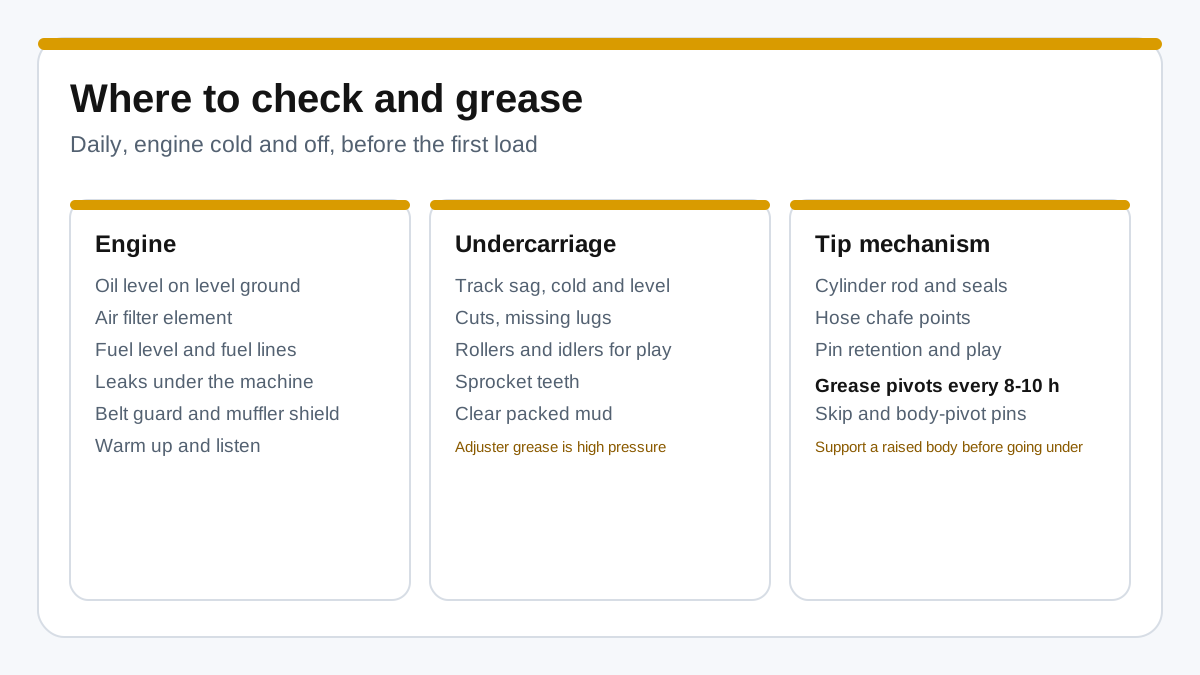
Do this before the first load, every day, with the engine cold and off. It takes a few minutes and it catches the failures that strand a machine.
- Engine oil level. Check on level ground with the dipstick seated per the manual's method. Top up with the specified grade; do not overfill.
- Air filter. Look at the element. A blocked filter makes a petrol engine run rich, lose power and wash oil past the rings. Clean or replace it sooner in dust.
- Fuel and leaks. Check the fuel level, look under the machine for oil or hydraulic fluid, and check hoses and the tank for weeping or chafing.
- Rubber tracks and undercarriage. Check track tension and look for cuts, missing lugs, cracked idlers or rollers, and packed mud. Clear debris from the sprocket.
- Tip cylinder and pivot pins. Look at the ram, its hoses and its mounting pins for leaks, wear or play. Grease the pivot points that your manual lists for daily or 8-to-10-hour service.
- Controls and guards. Check that drive and tip controls return to neutral, the parking brake holds, and belt guards, the muffler shield and the operator-presence control are in place and working.
Then start the engine, let it warm, and listen. Check that the tip function raises and lowers smoothly and the tracks drive straight. If the work is indoors or in a partially enclosed space, stop here: a petrol engine belongs outside. The trade-offs between petrol and battery power for enclosed work are covered in the petrol versus electric mini dumper buying guide; this article assumes you have already chosen petrol and now need to keep it running.
Engine service by the hour: the Honda GX-series example
The Honda GX120, GX160 and GX200 owner's manual publishes the schedule below. Many petrol mini dumpers use one of these engines or a close equivalent; if yours is a Loncin, Kohler, Briggs & Stratton or Honda GX270/GX390, the structure is similar but the exact hours and specifications will differ. Read your engine's own manual.
| Item | First service | Recurring interval | Notes |
|---|---|---|---|
| Engine oil, check level | Each use | Each use | Level ground, manual's dipstick method |
| Engine oil, change | First month or 20 hours | Every 6 months or 100 hours | SAE 10W-30, API SJ or later; about 0.56 to 0.60 L by model |
| Air filter, check | Each use | Each use | — |
| Air filter, clean | — | Every 3 months or 50 hours | "Service more frequently when used in dusty areas" |
| Air filter, replace | — | Every year or 300 hours | Paper element |
| Sediment cup, clean | — | Every 6 months or 100 hours | — |
| Spark plug, check and adjust | — | Every 6 months or 100 hours | BPR6ES (NGK); gap 0.70 to 0.80 mm |
| Spark plug, replace | — | Every year or 300 hours | — |
| Spark arrester, clean | — | Every 6 months or 100 hours | If fitted |
| Idle speed, check and adjust | — | Every year or 300 hours | Servicing dealer unless you have the tools |
| Valve clearance, check and adjust | — | Every year or 300 hours | Servicing dealer |
| Combustion chamber, clean | — | After every 500 hours | Servicing dealer |
| Fuel tank and filter, clean | — | Every year or 300 hours | Servicing dealer |
| Fuel tube, check | — | Every 2 years | Replace if necessary |
Two practical points the manual makes. First, use a 4-stroke automotive detergent oil that meets API SJ or later; SAE 10W-30 is recommended for general use, with capacity around 0.56 litre on a GX120, 0.58 on a GX160 and 0.60 on a GX200, so confirm your engine's figure. Second, the schedule "applies to normal operating conditions"; sustained high load, high temperature, or wet and dusty work means you consult the servicing dealer for shorter intervals.
Off-season storage adds one job the hour meter never shows: stale petrol. If the machine will sit for weeks, either run the carburettor dry or treat the fuel, because a gummed carburettor is the most common no-start on a stored small engine.
Drive and hydraulic system
This is the half of the machine your operator manual governs, and the intervals vary more between builders than the engine intervals do. What is consistent:
- Every day: check the hydraulic fluid level and inspect the pump, motor, hoses, fittings and the tip cylinder for leaks. A hydrostatic drive that is low or aerated loses drive power and runs hot.
- Break-in: most compact machines specify an early first change of hydraulic oil and the filter, often within roughly the first 50 hours, to clear assembly debris. Do not skip it; it protects the pump and drive motors for the rest of the machine's life.
- Periodic: after break-in, follow your manual's recurring figures. On the wider class of mini construction equipment, hydraulic filter changes are commonly scheduled around 500 hours and a full hydraulic oil change around 2,000 hours, but a small dumper may differ, so use your manual.
- Every service: check drive belt tension and condition where the machine uses a belt between engine and pump, and check that the parking brake and neutral return still work correctly.
Use the hydraulic fluid type and grade your manual specifies. Mixing incompatible fluids or using the wrong viscosity is a slow, expensive way to damage a pump.
Undercarriage: rubber tracks, rollers and idlers
Track tension is the single most-missed adjustment on a tracked dumper, and both a loose track, which throws, and an over-tight track, which wears the sprocket, idler and bearings, shorten undercarriage life.
Check sag on firm, level ground with the tracks cold, because a warm track from a grease adjuster reads tighter than it is. Undercarriage guidance from track suppliers puts typical sag at about 10 to 15 mm (0.4 to 0.6 in) between the rubber track and the bottom roller nearest the centre, but the exact figure and the exact measurement point belong to your machine's manual, and some manuals specify measuring a jacked track instead. Adjust by pumping a grease gun into the track adjuster nipple to tighten, or backing off the release valve to loosen.
A safety point that matters: the track adjuster cylinder holds grease under high pressure. Open the release valve only a fraction of a turn, let grease seep out slowly, and never remove the valve or grease fitting to "speed it up." Use the grease your manual calls for; undercarriage guidance generally recommends a good-quality lithium multipurpose or extreme-pressure grease.
Check tension daily or on the interval your manual gives, some builders say every 50 hours. On the same schedule, inspect the rollers and idlers for seized bearings and oil weeping past their seals, and the drive sprocket for hooked or worn teeth. Clear packed soil after each shift; mud left to set is abrasive and holds moisture against metal.
Tip cylinder, pivot pins and greasing
The hydraulic tip is a small system with a large consequence if it fails with a load raised. On the daily walkaround and again at each hour-based service:
- Grease every pivot the manual lists: skip pins, body-pivot pins, and the cylinder eye ends. Exposed pins on a machine working in grit often need grease every 8 to 10 hours, not weekly.
- Inspect the cylinder for rod scoring, seal weeping and secure pin retention. Check the tip hoses for chafe points where the body moves.
- Check the body prop or support device. Never put any part of your body under a raised skip that is not mechanically supported. Hydraulics can drift down.
- Watch for play. Worn pins and bushes let the body rock; that wear accelerates once it starts and can crack mounting brackets.
Adjusting intervals for real conditions
The published schedule is a starting point for "normal" use. Mini dumpers rarely work in normal conditions. Maintenance guidance for small construction equipment, and Honda's own severe-conditions note, both say to shorten intervals when the machine sees:
- Dust from demolition, dry soil or concrete cutting: service the air filter far more often, and bring the oil change forward.
- Heat and high load from full skips on gradients and long push cycles: oil degrades faster.
- Mud and water: undercarriage inspection and greasing move to every shift.
- Extended idling, common on sites with a lot of waiting: idle hours are hard on oil and plugs without registering as productive work.
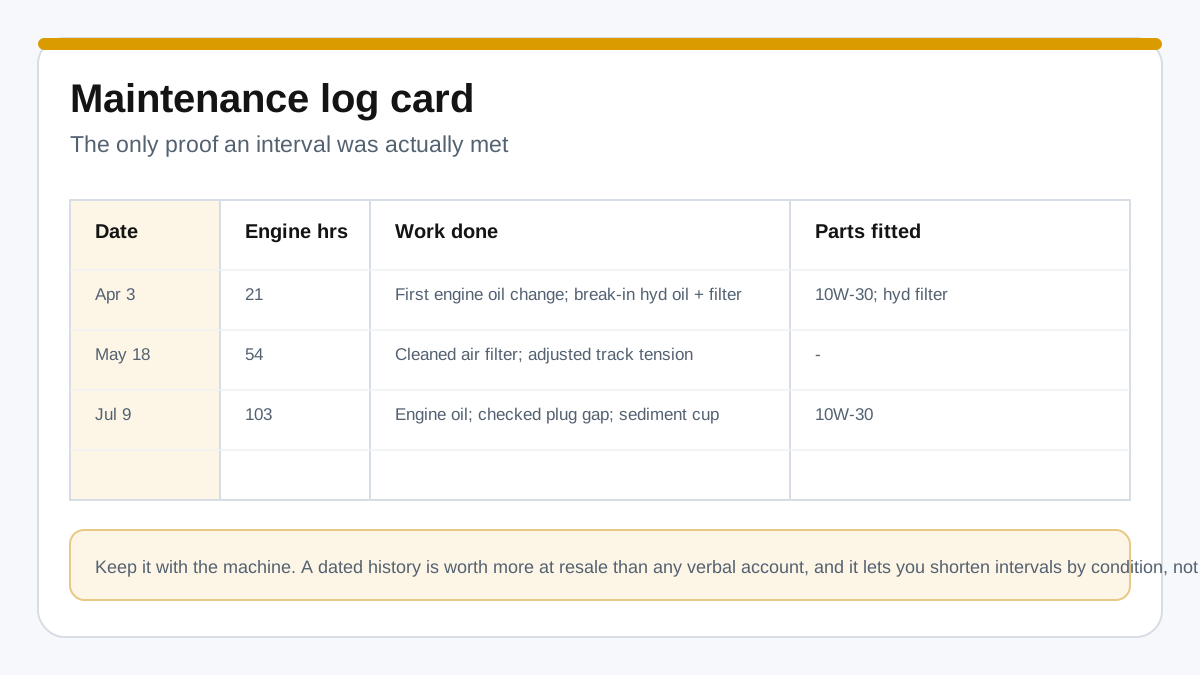
A commonly cited rule of thumb is to cut intervals by 20 to 30 percent under severe service, but the honest version is: watch the oil, watch the filter, and let condition, not just the hour meter, call the next service. Keep a simple log. A dated record of hours, work done and parts fitted is worth more at resale than any verbal history, and it is the only way to know an interval was actually met.
Get the parts list before the season starts
Downtime on a small machine is usually a missing filter, not a broken engine. Send TerraCub the model and serial number of your petrol tracked dumper and the team can return the oil, air-filter, spark-plug, belt, track, roller and tip-cylinder part numbers with the schedule they apply to.
Request a parts and service briefBuild a parts and service brief before you need it
Before the season, write down:
- Engine make, model and serial number, and the part numbers for the oil filter (if fitted), air filter element, spark plug and drive belt.
- Engine oil grade and capacity, and the hydraulic fluid type and capacity from the operator manual.
- Track part number and width, and the roller and idler part numbers.
- Tip cylinder seal kit and pivot pin and bush part numbers.
- The pre-use checklist and the hour-based schedule, printed and kept with the machine.
If you are speccing or supporting a fleet of petrol tracked dumpers, TerraCub can supply this list against a specific model. See the TerraCub petrol tracked mini dumper range for the machines these schedules apply to, and About TerraCub for how the company supports machines after the sale.
FAQs
How often should I change the oil in a petrol mini dumper?
On a Honda GX-class engine the manual calls for the first oil change after 20 hours or one month, then every 100 hours or six months, using SAE 10W-30 rated API SJ or later. Bring that forward in dust, heat or heavy load, and change it at least once a season even on a machine with low hours, because oil oxidises with time. Your engine manual has the exact figure for your unit.
What engine oil does a petrol mini dumper use?
Most small air-cooled petrol engines specify a 4-stroke automotive detergent oil meeting API SJ or later, with SAE 10W-30 for general-temperature use. Capacity on the common Honda GX120/160/200 engines is roughly 0.56 to 0.60 litre. Check the API rating on the bottle and confirm the grade and capacity in your engine manual, because some engines and climates call for a different viscosity.
How tight should the rubber tracks be?
Track-supplier undercarriage guidance puts typical sag at about 10 to 15 mm (0.4 to 0.6 in) between the track and the bottom roller nearest the centre, checked on firm level ground with the tracks cold. Your machine's operator manual gives the figure and the measurement method that actually apply, and some specify measuring a jacked track. The adjuster holds grease under high pressure, so loosen the release valve only slightly and never remove it.
Do I need to service the hydraulics on a mini dumper?
Yes. Check the fluid level and inspect for leaks every day, do the early break-in hydraulic oil and filter change your operator manual specifies (often within the first 50 hours), then follow its periodic change intervals. Also grease the tip cylinder pivot pins on the schedule the manual lists, frequently every 8 to 10 hours for exposed pins on a machine working in grit.
Can I follow a fixed hours schedule for any mini dumper?
Use the hour-based structure, a first service near 20 to 25 hours then work around 50, 100 and 300-plus hours, as a planning framework, but take every specific number from your engine manual and your dumper's operator manual. Different engines have different oil, plug and valve intervals, and different drives have different fluid and filter points. Severe conditions shorten all of them.
What should the daily pre-use check cover?
Engine oil level, the air filter, fuel level and a look for leaks, rubber-track tension and undercarriage condition, the tip cylinder and its pivot pins, and that the controls return to neutral and the guards and operator-presence control work. Then start up, warm the engine and confirm the tip and drive functions are smooth.
Sources and limitations
- Honda GX120 / GX160 / GX200 owner's manual (maintenance schedule table, recommended oil SAE 10W-30 API SJ or later, oil capacity by model, spark plug BPR6ES and gap 0.70 to 0.80 mm, and the "log hours of operation" and severe-conditions notes; figures apply to these Honda engines only)
- Fortis HD, Adjusting Track Tension on Mini Excavators (typical rubber-track sag 10 to 15 mm / 0.4 to 0.6 in, cold-and-level check, grease-cylinder adjuster method, check frequency; general undercarriage guidance, not a manual for any specific dumper)
- Hour-based service framework for small construction equipment (daily/10-hour, 50-hour, 250/500/1,000/2,000-hour intervals; hydraulic filter near 500 hours; hydraulic oil near 2,000 hours; 20 to 30 percent interval reduction under severe service) is drawn from published mini-excavator and compact-equipment maintenance guidance and used here only as a planning structure, not as a schedule for any specific mini dumper.
This guide gives typical intervals for this class of machine. It does not set a universal oil specification, fluid capacity, service interval, track-tension figure or torque value for your dumper. Your engine manufacturer's manual and your dumper's operator manual give the exact figures; follow those. Work requiring the engine builder's shop manual or special tools should go to a qualified mechanic.
Recommended Products
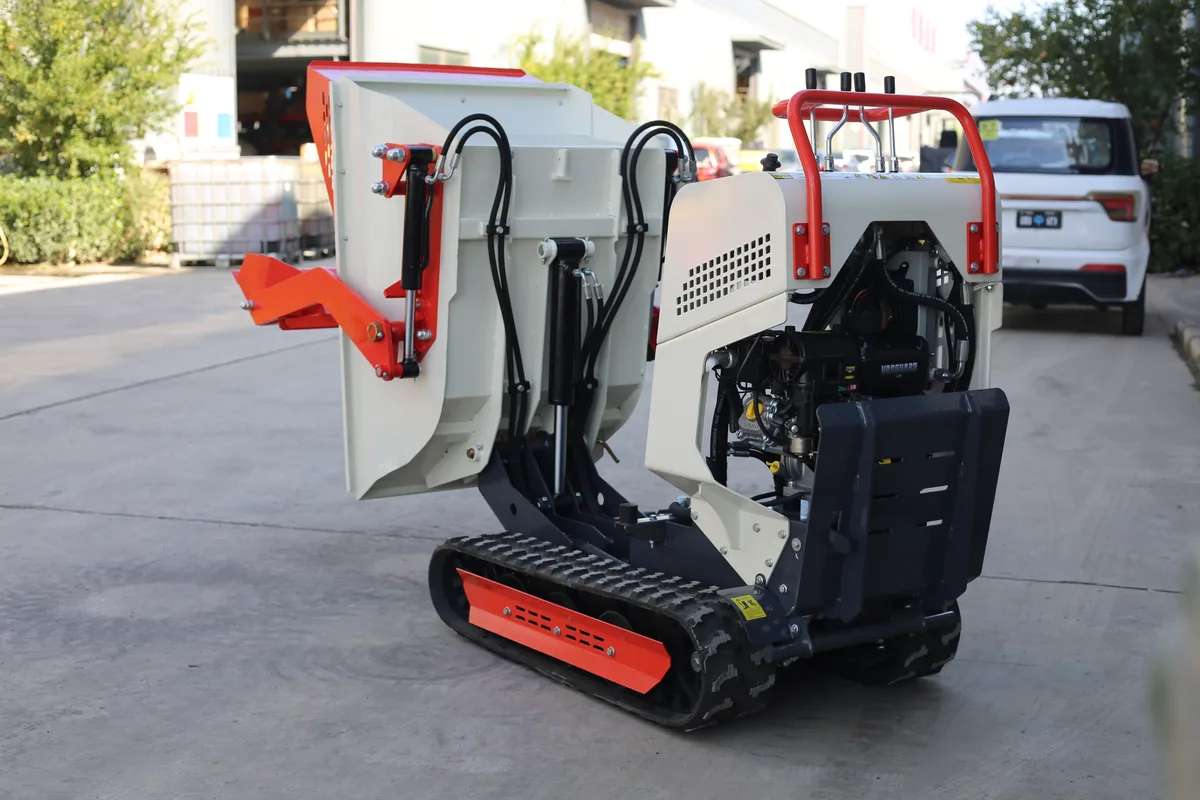 Small Dumper Truck 500kg
Entry-level tracked dumper. Passes through standard residential gates. Ideal for garden work, landscaping, and light construction.
View Product →
Small Dumper Truck 500kg
Entry-level tracked dumper. Passes through standard residential gates. Ideal for garden work, landscaping, and light construction.
View Product →
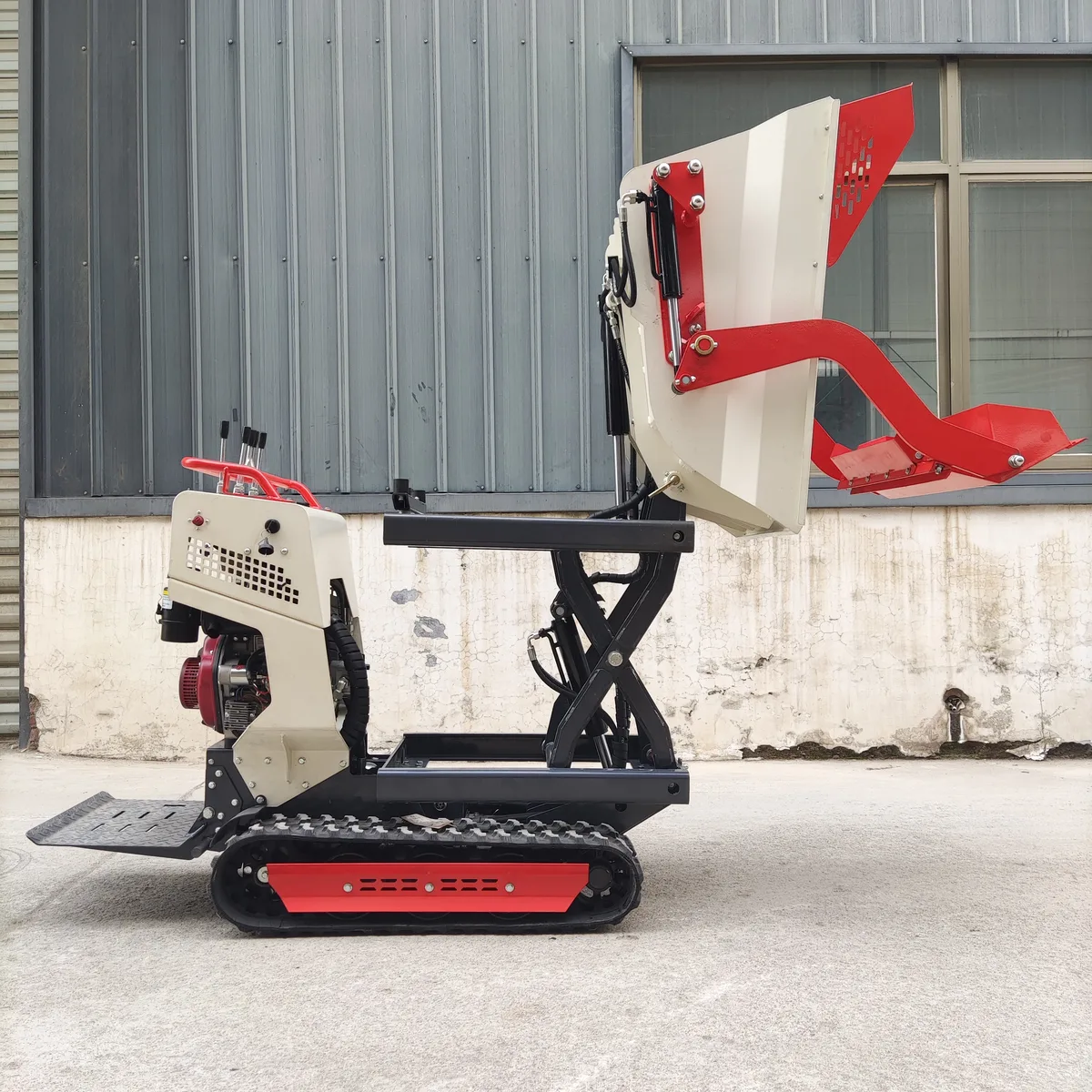 High Tip Mini Dumper
Same narrow 700 mm body. Lifts the bucket to 1,200 mm, enough to dump over scaffolding, into mixers, or above formwork.
View Product →
High Tip Mini Dumper
Same narrow 700 mm body. Lifts the bucket to 1,200 mm, enough to dump over scaffolding, into mixers, or above formwork.
View Product →
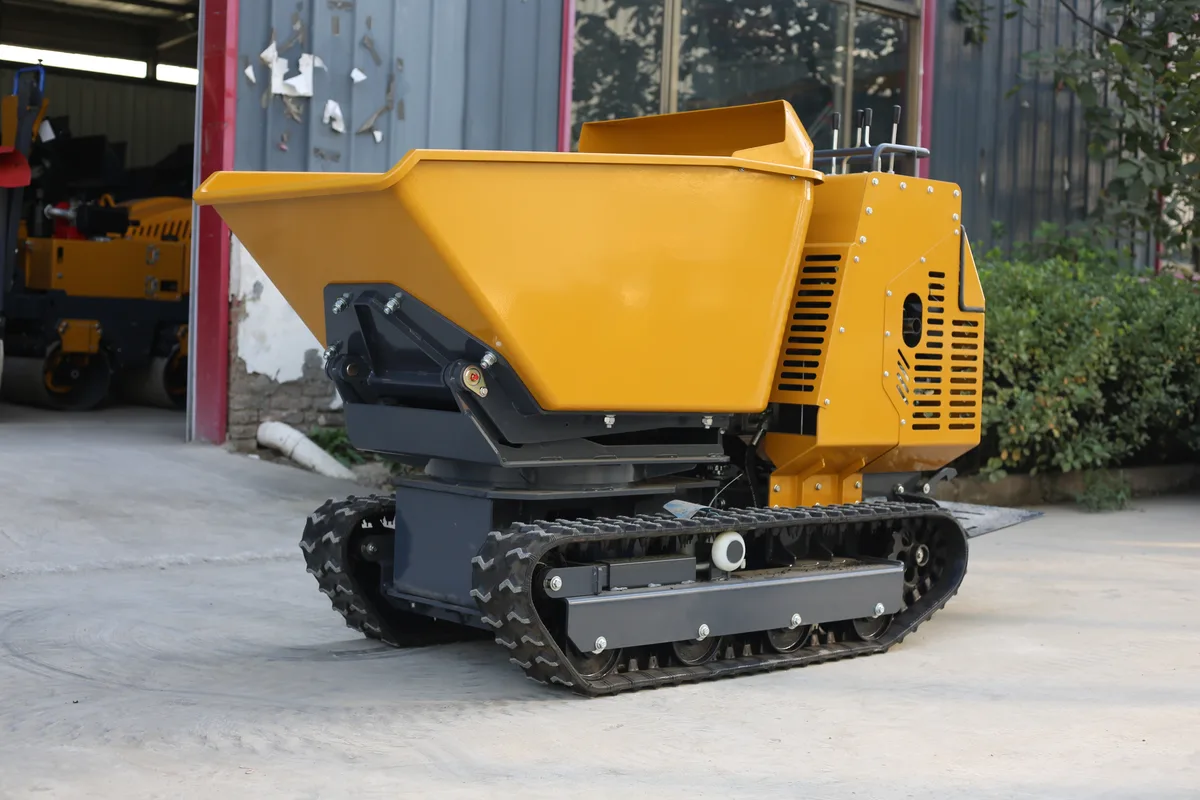 Rotary Dump Mini Dumper
2.4x the payload. Rotary base dumps in any direction without repositioning. Built for commercial sites and heavy excavation.
View Product →
Rotary Dump Mini Dumper
2.4x the payload. Rotary base dumps in any direction without repositioning. Built for commercial sites and heavy excavation.
View Product →