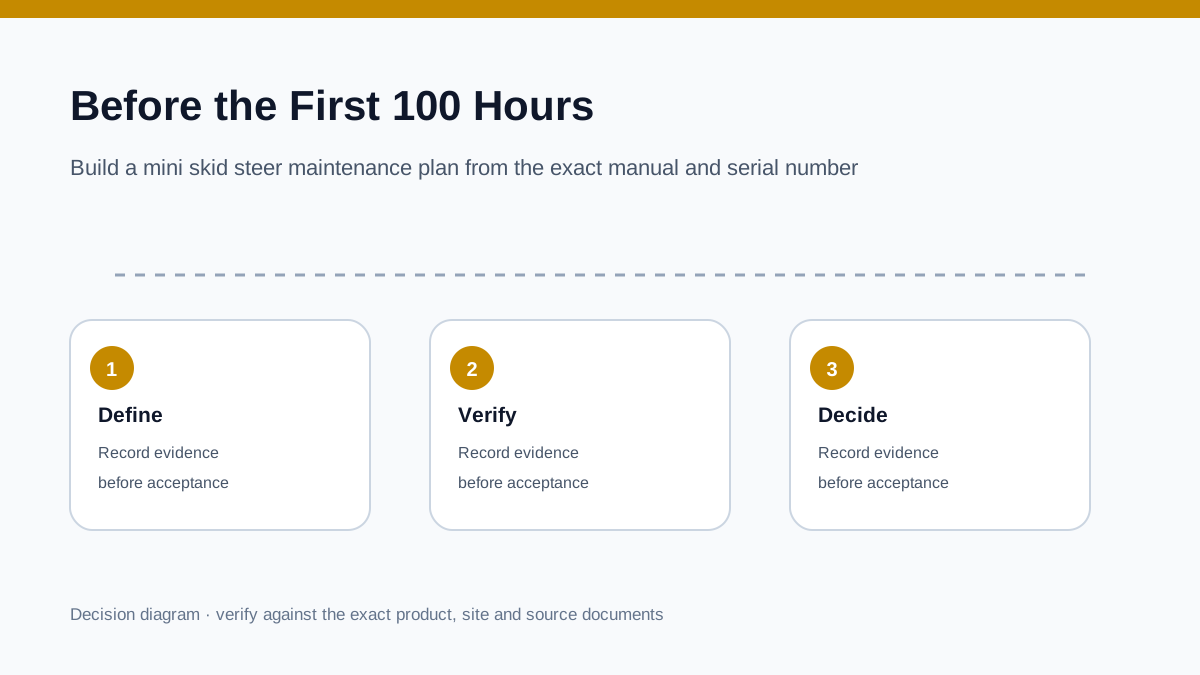
Mini Excavator Rubber Track Maintenance: Check Wear and Verify Tension Before You Adjust
Inspect mini excavator rubber tracks, record wear and debris, and verify the exact machine manual before measuring or adjusting tension.

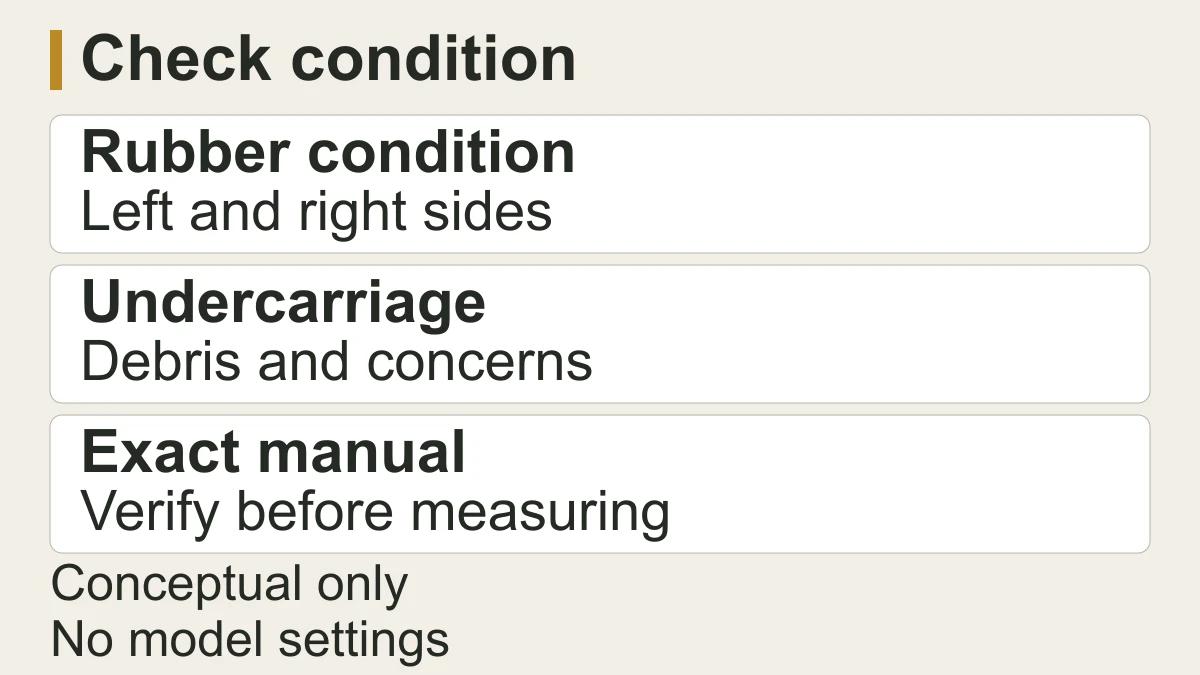
Mini excavator rubber track maintenance starts with checking the rubber and supporting undercarriage for damage, debris and uneven wear. Treat unusual sag as a reason to verify tension, rather than a setting you can judge by eye. Use the manual for the exact machine and track type before measuring or adjusting. When damage or abnormal operation raises a service concern, suspend use for review instead of trying to solve it by tightening the track.
What to inspect before work
A useful walkaround records what you can see and what that observation requires next. It does not end with “tracks checked” when one side has a deep cut, packed mud or a leaking roller.
Start with the machine's applicable safety instructions and a ground-level visual inspection. This guide does not explain how to lift or support an excavator, work beneath it or release tensioner pressure. Those actions need the exact machine procedure and appropriate service competence.
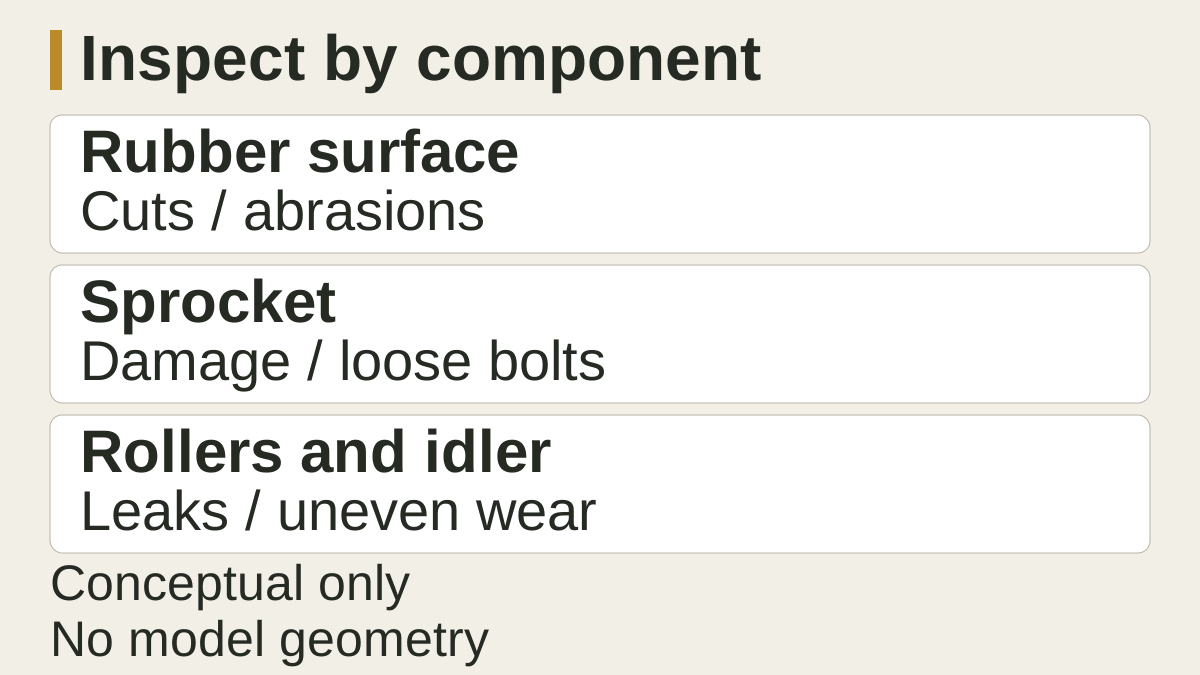
In its rubber-track maintenance guidance, Cat identifies deep cuts or abrasions, packed debris, sprocket damage or loose bolts, and roller or idler leaks and uneven wear as items to inspect. It also identifies unusual sag, especially a track contacting components during operation, as a reason to measure tension. These are useful inspection topics; Cat's machine setup and measurement details are not universal instructions for every mini excavator.
| Inspection area | Observation to record | Next decision |
|---|---|---|
| Rubber surface | Location and appearance of cuts or abrasions; a photo of anything concerning | Record the damage and seek service assessment when it is material; do not invent a replacement limit from appearance |
| Track and undercarriage debris | Packed mud or trapped material visible from the safe inspection position | Follow the machine's permitted cleanout method, then reassess the visible condition |
| Sprocket | Visible damage or loose bolts | Request service review rather than treating the issue as a tension adjustment |
| Rollers and idler | Visible leakage or uneven wear | Record which component and side are affected for service assessment |
| Track position and operation | Unusual sag or reported contact with another component | Verify the applicable tension-measurement method; abnormal operation also needs service review |
Keep left and right observations separate. “Mud around left idler” is more useful than “undercarriage dirty.” Likewise, a photo tied to a component and side gives the next person a clearer record than a general note about wear.
The Kubota U25 manual calls for cleaning tracks after use and removing caught obstacles before track-tension adjustment. That instruction belongs to the U25. For another machine, confirm its own cleaning method and inspection requirements rather than copying an operating sequence from the example. This article provides no pressure-washing, track-rotation or raised-machine cleanout procedure.
Why sag alone does not tell you the correct tension
A visibly loose-looking track gives you a question to investigate. It does not supply the correct clearance, measurement point or machine position.
Cat explains that excessive tension can accelerate wear, while insufficient tension can cause derailment or drive-lug jumping. Tightening until a track “looks better” therefore substitutes an impression for the specified measurement. It also leaves the original observation—damage, debris or an undercarriage issue—unresolved.
Before arranging a tension check, verify these details in the applicable manual:
- The exact machine identity and whether the instructions cover its fitted track type.
- The required machine condition and safe measurement method.
- The diagram and the two surfaces between which clearance is measured.
- The specified range and any relevant conditions attached to it.
- The applicable recheck and service instructions.
Do not fill a missing item with a value from another model or an online picture. Cat explicitly says track values vary by machine and directs users to their Operation and Maintenance Manual. A measurement taken at the wrong point cannot be compared confidently with a specification describing a different gap.
Daily visual inspection and tension adjustment are also different decisions. A walkaround may identify a reason to verify tension; it does not establish that adjustment is required every day. Keep the visual observation, the measured result and any authorized service action as separate entries.
What the Kubota U25 example shows about manual scope
The Kubota U25 operator manual, in “Adjustment of Tracks” on printed pages 50–51, identifies a track seam position and a particular roller-to-track measurement geometry. It also discusses removing caught obstacles and rechecking tension. Those details show why “measure the sag” is incomplete without an identified machine and diagram.
A reader working on another excavator should use the example to ask better documentation questions: Which track position does my manual require? Which roller and track surface define the gap? What conditions apply to the reading? The U25 answers cannot automatically become that other machine's answers.
No numerical tension range, tightening torque or service interval is reproduced here. The retrieved U25 text interleaves diagram values, so those figures cannot be assigned reliably from that extraction. The original applicable diagram must be verified before a service decision uses a number. The manual's revision date was not confirmed during this review.
The same boundary applies to TerraCub models. An OEM example helps explain the need for a model-specific procedure; it does not establish a TerraCub tension setting, approved lifting method or compatible replacement track.
Choose maintenance, verification or service review
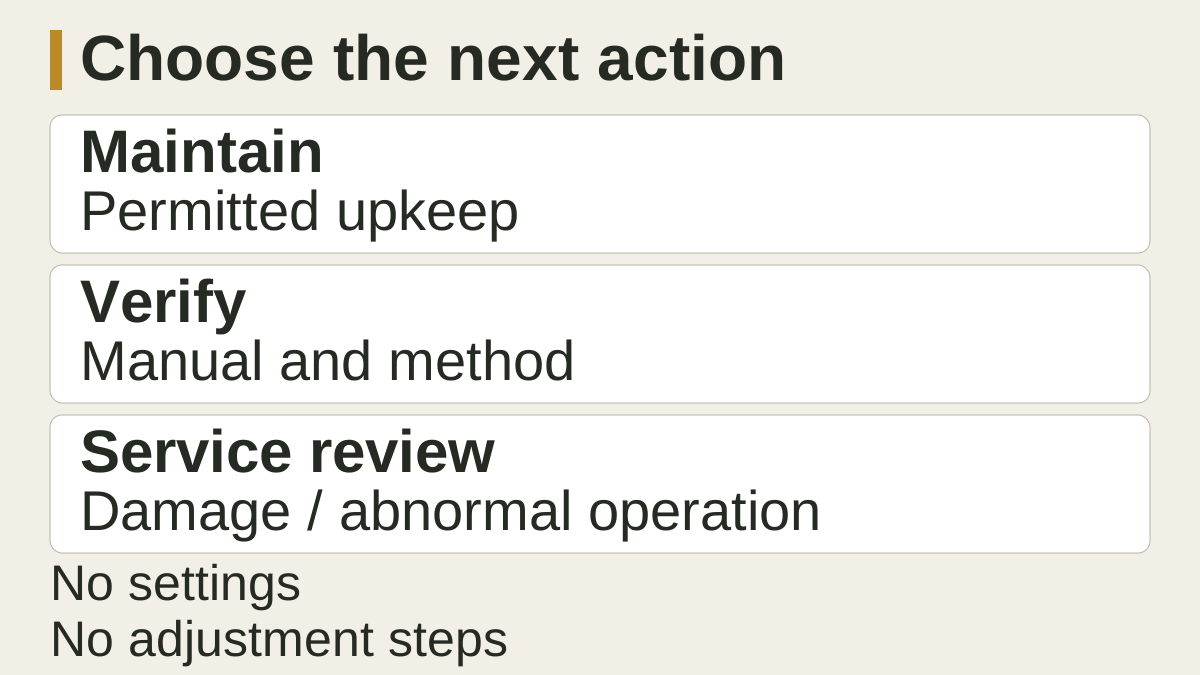
The next action should follow the observation and available evidence. Routine upkeep, an unresolved measurement question and a material defect should not all be recorded as “adjust track.”
The following table is an editorial decision aid based on the selected OEM guidance. It is not an OEM-approved checklist or a declaration that a machine is safe to operate.
| Route | What puts the observation here | What to do next | What remains unconfirmed |
|---|---|---|---|
| Maintain | Routine debris or upkeep covered by the exact manual, without a separate material damage concern | Use the permitted maintenance method and record the resulting condition | Appearance does not confirm tension or rule out a hidden defect |
| Verify | Unusual sag, a missing specification, uncertain measurement points or an unclear manual match | Identify the applicable manual and method before measurement or adjustment | Correct tension until an applicable reading is obtained and compared |
| Suspend for service review | Material visible damage, component leakage, sprocket damage or loose bolts, or abnormal track operation | Suspend use and pass the observation, photos and machine identity to qualified service | Cause, repair scope and replacement need until assessed |
A concern can belong to more than one route. Packed mud and a visibly damaged component, for example, should not be reduced to a cleaning task. Record both and preserve the service concern.
There is also a firm boundary around tensioner work. The U25 manual warns about high-pressure grease, prohibits crawling beneath the excavator, and says not to rely solely on hydraulic support or dismantle the tensioner spring. This guide supplies no valve-release recipe, lifting sequence, grease-gun procedure or track-remount tutorial. If the required method, support arrangement or service competence is uncertain, stop at documentation and qualified review.
Keep an inspection and manual-verification log
A short record makes the next inspection or service discussion more specific. The important distinction is between what was observed and what was verified. A blank reading field is more truthful than an estimated sag value.
Use the worksheet below as an editorial record. Fill measurement fields only when the applicable OEM method has been verified and the reading can be obtained safely by the appropriate person.
| Record field | What to enter |
|---|---|
| Inspection identity | Date, inspector and machine hours if available |
| Machine identity | Model, serial or build identity, and fitted track type |
| Manual reference | Manual title/revision and the relevant section, page and diagram |
| Left-side observations | Rubber condition, debris, component concern and associated photos |
| Right-side observations | The same observations recorded separately |
| Measurement basis | Exact measurement points and conditions stated in the applicable manual |
| Applicable specification | Transcribe only from the verified original manual; otherwise mark “not verified” |
| Actual readings | Left and right results obtained under that method; otherwise leave blank |
| Decision and follow-up | Maintain, verify or suspend for service review; responsible contact and outstanding question |
For a documentation request, a record such as “unusual sag on the left; model and serial attached; correct measurement diagram not yet verified” is useful without pretending to diagnose the problem. It makes the missing evidence explicit and gives the recipient a concrete question to answer.
Keep the observation photos with the record. If a specification or manual match is later confirmed, retain that reference alongside the reading so a future review can see the basis for the decision.
Ask for documentation for the exact machine
The current TerraCub mini excavator range provides a starting point for identifying the catalogue model. The retrieved source includes 06Q and 12Q product routes, but it does not establish their track-tension values, replacement-track compatibility or applicable adjustment procedures.
For an existing machine, prepare its model and serial or build identity, the fitted track type, clear condition photos and any manual already available. Ask which documentation applies and which support options can be confirmed. A catalogue model name alone should not become a parts-fit promise or a substitute for the maintenance manual.
If you are still choosing a machine, the mini excavator selection guide covers access, digging range and broader buying decisions. Keep those selection questions separate from the service assessment of a track already showing a concern.
Ask TerraCub about the exact machine documentation, attaching the inspection record and the question still unresolved. Confirm documentation and support availability before relying on a reply as a service plan.
FAQs
How tight should a mini excavator rubber track be?
Use the specification and measurement method in the manual for the exact machine and fitted track type. Cat says track values vary by machine. The U25 manual illustrates model-specific positioning and measurement geometry; its values are not a specification for another excavator. This guide supplies no universal sag number.
Does a daily track check mean daily adjustment?
No. Cat's daily checks concern visible condition, debris and undercarriage components. An unusual observation can lead to a tension check, but adjustment depends on the applicable manual and measured result. Follow the exact machine's requirements rather than turning a daily walkaround into an automatic adjustment schedule.
What if I cannot verify the manual for my machine?
Record the model and serial or build identity, track type, concern and photos, then request the applicable documentation. Do not substitute another model's setting or procedure. If material damage or abnormal operation creates a service concern, suspend use for qualified review while the documentation question is resolved.
Sources used in this guide
- Cat: How to Maintain Cat Rubber Tracks, dated August 17, 2026. Used for written inspection topics, qualitative tension risks and the exact-manual requirement.
- Kubota U25 operator manual, printed pages 50–51 and Safe Operation maintenance warnings. Used as an explicitly model-scoped example; revision date unverified and numerical settings excluded.