Skid Steer Breakout Force vs Rated Operating Capacity: What Each Number Means
Understand skid steer breakout force, rated operating capacity and tipping-load bases. Check exact model labels and configuration before comparing a quote.

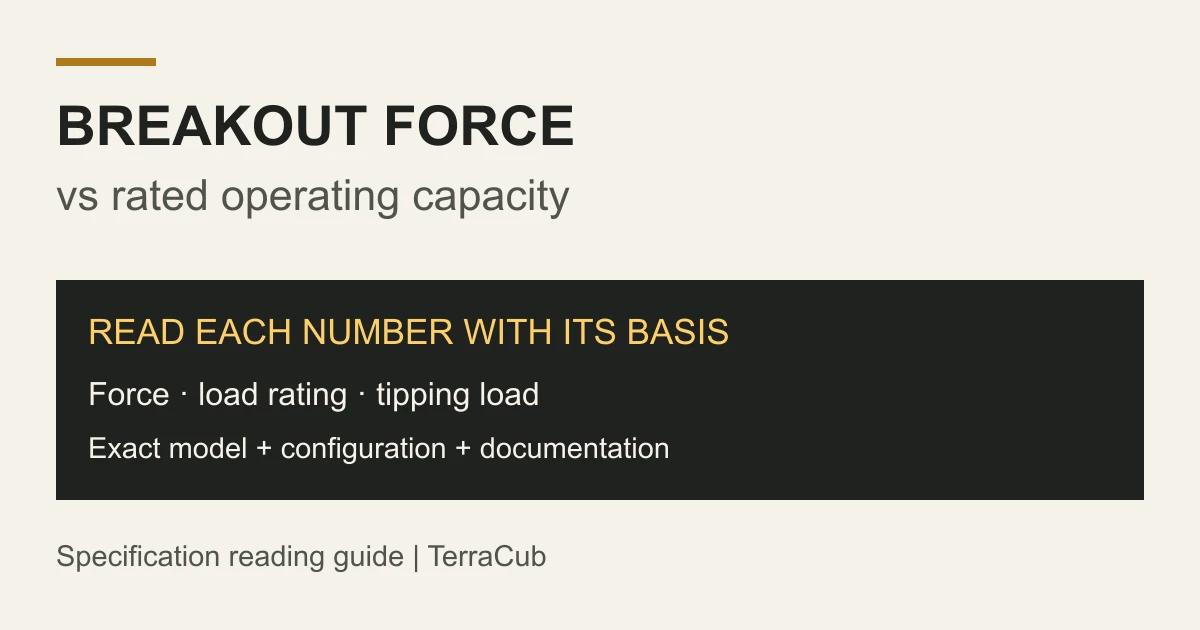
Direct answer: Skid steer breakout force and rated operating capacity describe different specification fields. Breakout figures describe force associated with the bucket or lift arm; ROC is a load rating with a stated basis. Tipping load is another separately reported field. Read the exact label, unit and model documentation before comparing numbers. A breakout-force figure cannot supply a missing ROC rating, and an unexplained supplier “rated load” label should remain unexplained until its documentation establishes the basis.
A quick comparison of the three fields
| Field on the specification sheet | What to look for | What the number does not establish by itself |
|---|---|---|
| Bucket or lift-arm breakout force | Which component is rated, the force unit and the stated measurement or limiting basis | An approved carrying load or a substitute for ROC |
| Rated operating capacity (ROC) | The manufacturer's declared rating, its relationship to the documented tipping basis and the applicable configuration | A rating for another attachment or an undocumented supplier label |
| Tipping load | The separately stated tipping-load figure and the configuration to which it belongs | Permission to use that figure as an operating load |
The table is a way to read a specification, rather than a calculation of what a loader can safely handle on a particular job. Keep the machine's applicable documentation with the comparison.
Read force and load as separate entries
A useful place to see the distinction is Kubota's SSV Series specification sheet. Its SSV65 and SSV75 table lists rated operating capacity, tipping load and breakout force in separate rows. Breakout force is split again into bucket and lift-arm entries. The load rows use lb (kg), while the force rows use lbf (kgf).
Those labels matter even when an abbreviated sales sheet makes the figures look similar. The “f” in a force unit belongs with the number. Copying a force figure into a load-capacity column, or dropping the bucket-versus-arm distinction, changes what the supplier actually reported. Preserve the original field and unit before attempting a comparison.
For example, a quote that gives only “breakout force” leaves an important question unanswered: does it refer to the bucket, the lift arm, or a different declared basis? Ask for the specification row and its supporting document. A larger figure is not enough information to resolve that question.
The Kubota sheet provides a concrete example of reporting categories. It does not define the rating basis of every skid steer, and its units should not be used to reinterpret an unrelated supplier's labels.
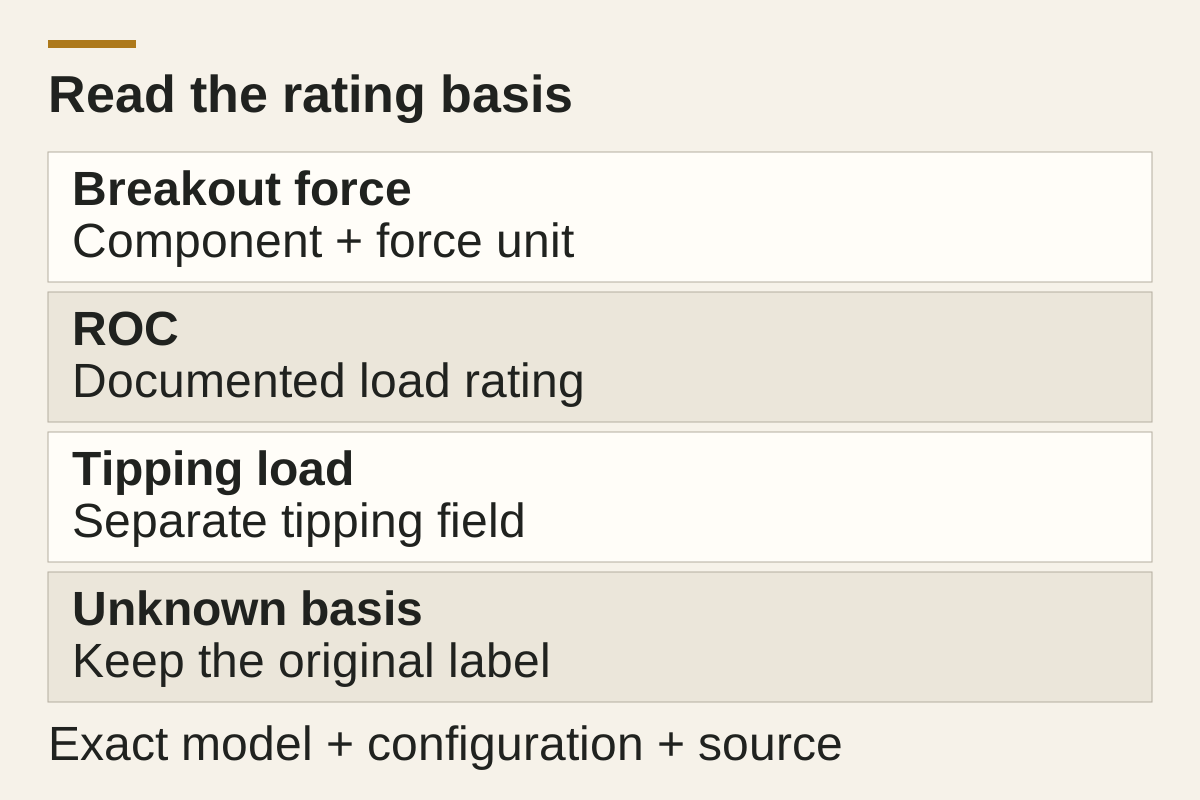
Read ROC beside its documented tipping basis
In the same Kubota SSV sheet, the ROC row is explicitly labeled “Rated operating capacity—50% tipping load.” The tipping-load row remains separate. That stated relationship helps explain those two fields for the models covered by that document.
It is tempting to turn a familiar percentage into a rule for any quoted machine. Keep the document's boundary instead: this sheet declares a basis for its SSV models. It does not establish the basis of a TerraCub catalog field, another manufacturer's machine, or a different configuration. If a quote does not state its rating basis, record “basis not supplied” and request it.
The practical question is therefore more specific than “what percentage should I use?” Ask: which document defines this exact model's rated capacity, and which configuration does that document describe? That answer allows the capacity and tipping figures to be read together without inventing either one.
This guide does not calculate an operating load from tipping load. Use the applicable machine and attachment documentation for the operating decision.
Keep configuration attached to the rating
The Bobcat Classic S650 specification page shows why a model name alone may be an incomplete comparison key. It separately lists rated operating capacity, tipping load, and ROC entries identified by counterweight configuration.
A base rating and a counterweight-labeled rating should retain those labels in a comparison sheet. Otherwise, a buyer can end up comparing one machine's base configuration with another configuration while believing both figures describe the same setup.
The page also qualifies its specifications as comparison figures that can vary with the individual equipment and operating conditions. Use it as an attributed configuration example, then obtain the documentation that applies to the actual machine under consideration. Do not derive a general counterweight adjustment formula from those listed entries.
When requesting a rating, include the exact model, the fitted bucket or attachment, and the counterweight or other configuration identified in the manufacturer's document. Record any remaining configuration questions as questions. An empty field is more useful than a confident assumption that changes the meaning of the rating.
Lift-path geometry is a separate decision. If reach through the lift cycle is also part of the job, use the dedicated radial lift versus vertical lift guide alongside the rating documents. A lift-path description does not fill a missing capacity basis.
Check what the breakout figure includes
Breakout force also needs its own qualification. The New Holland L315 page for Africa and the Middle East states that its breakout forces are estimated considering both tip and hydraulic limits.
That footnote is useful because it keeps the comparison grounded in what the manufacturer actually declares. It would be misleading to describe that reported figure as a hydraulic-only number while omitting the tipping-limit qualification. It would also be misleading to assume the same footnote defines every other manufacturer's breakout figure.
Put the component, unit and limiting or test basis next to the force value. Where the source does not provide them, request the missing information. The purpose is to identify comparable fields, rather than choose whichever isolated number looks largest.
Preserve supplier labels when their basis is unknown
TerraCub's current model 25 catalog illustrates another common reading problem. It separately labels rated load, maximum load and maximum breakout force. Those entries do not, on their own, declare a standardized ROC-to-tipping-load test basis.
Keep those names in your worksheet. Do not rename “rated load” as ROC, rename “maximum load” as tipping load, or treat the breakout entry as a lifting-capacity figure. The missing basis is a documentation question, rather than a number to infer from the other rows.
This distinction is especially useful when two quotes use different terminology. A sheet with a documented ROC field and a sheet with an unexplained rated-load field have not yet supplied equivalent evidence. Ask the supplier to explain the second field before placing both values in one ranked capacity column.
The same approach applies to omissions. If the sheet does not identify the bucket or lift-arm component of a breakout figure, leave that field unresolved. If it does not identify the relevant configuration, request it. Preserve the uncertainty until the exact-model documentation resolves it.
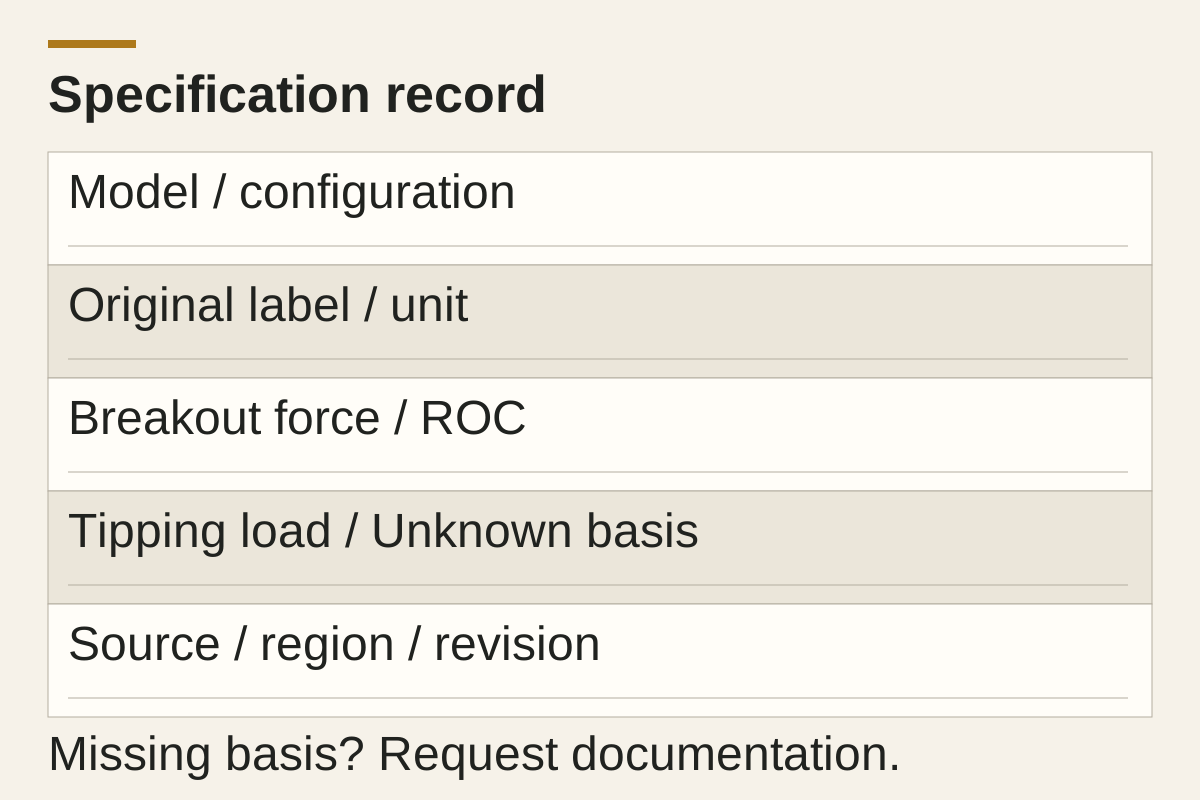
Use a specification comparison worksheet
Start with the manufacturer's wording. Complete one row for each proposed machine and retain the source document or revision with it.
| Information to record | Machine A | Machine B | Follow-up if missing |
|---|---|---|---|
| Exact model and quoted configuration | — | — | Request the model/configuration sheet |
| Bucket or attachment identified in the documentation | — | — | Request the applicable attachment details |
| Original capacity label and unit | — | — | Ask what the label means; keep its original wording |
| Declared ROC and its documented basis, if supplied | — | — | Request the rating definition; do not calculate an assumed value |
| Separately declared tipping-load field | — | — | Request the source row and applicable configuration |
| Breakout component: bucket, lift arm or other declared basis | — | — | Request the component definition |
| Breakout force unit and stated limiting/test basis | — | — | Request the original specification and qualifications |
| Counterweight/configuration identified with each rating | — | — | Request the configuration-specific rating |
| Document title, region and revision or access date | — | — | Obtain a traceable source for each field |
The worksheet is an editorial comparison aid, rather than an OEM test standard or an operating approval. Its value is that the missing fields stay visible. Complete them before ranking machines by a supposedly equivalent capacity or breakout specification.
Prepare an exact-model specification request
Use the TerraCub skid-steer loader category to identify the model you want to discuss. Prepare its quoted labels and units, the bucket or attachment, the stated counterweight/configuration, and the rating or test-basis questions that remain unresolved. The category's existing Request Quote path leads to the contact page.
Ask for documentation that ties those fields to the exact proposed configuration. That gives the next discussion a clear purpose: resolve the missing specification basis before comparing a force figure with a load rating or choosing a machine from an unexplained number.
FAQs
What does breakout force tell me about a skid steer?
It identifies a reported force field that needs its component and basis attached. The Kubota SSV sheet separates bucket and lift-arm breakout force and labels those entries in lbf (kgf). New Holland's L315 footnote qualifies its breakout figures by both tipping and hydraulic limits. Read the exact source for the machine being compared, rather than assume that every breakout figure has the same definition.
Is breakout force the same as rated operating capacity?
No. The Kubota SSV specification sheet reports them as separate fields, using force units for breakout and load units for ROC. A force value cannot supply a missing capacity rating. Retain both labels and obtain the applicable rating documentation.
Why is rated operating capacity lower than tipping load on the SSV specification sheet?
The retrieved Kubota SSV sheet explicitly labels ROC as 50% of tipping load for the models it covers. That explains its reporting relationship. Do not transfer the percentage to another machine or an undocumented supplier field, and do not use tipping load as permission for an operating load.
Can a supplier’s rated-load label be treated as standardized ROC?
Only the supporting documentation can establish what that label represents. TerraCub's catalog preserves rated-load, maximum-load and breakout-force labels without declaring a standardized ROC-to-tipping basis in those fields. Keep the wording and request exact-model documentation through the existing loader category and quote path.
Sources used in this guide
Sources and scope
- Kubota SSV Series specification sheet, retrieved for this article: US SSV65/SSV75 sheet, ©2024; page 2 distinguishes ROC, tipping load, bucket/lift-arm force and units. The model-specific reporting relationship is not generalized to other machines.
- Bobcat Classic S650 specifications, accessed October 9, 2026 UTC: an example of separately identified base and counterweight ROC entries; specifications remain subject to the manufacturer's qualifications.
- New Holland L315, Africa/Middle East, accessed October 9, 2026 UTC: model/region-specific tip-and-hydraulic breakout qualification.
- TerraCub's current model 25 catalog fields: observed supplier labels only. They are not relabeled as standardized ROC or tipping-load ratings.
This article explains specification reading. It provides no universal ROC percentage, force-to-capacity conversion, field-test result or job-specific safe operating limit.